When to Start Seeds Indoors: Weeks Before Last Frost
When to start seeds indoors, crop by crop, counted from the NOAA last frost date and the transplant ages Colorado State Extension publishes.
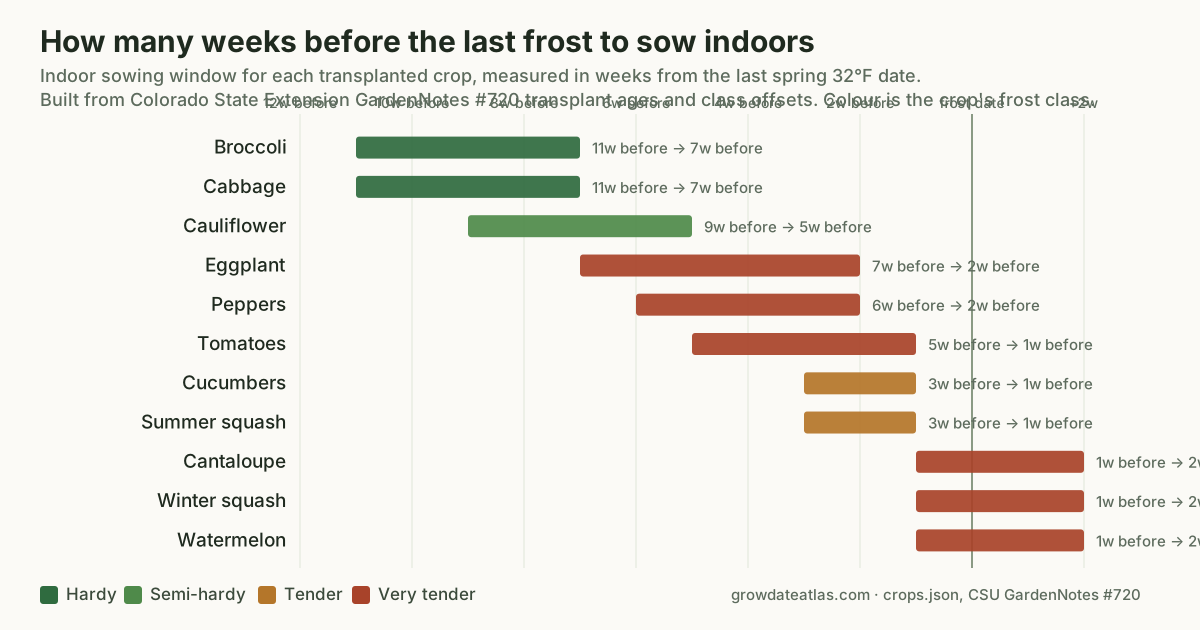
When to start seeds indoors is the one planting question almost every chart answers with the wrong arithmetic. The usual rule, "six to eight weeks before your last frost", counts a transplant age back from the frost date — but tomatoes do not go into the garden on the frost date. They go in two to four weeks after it. Count from the right anchor and the answer moves by up to a month.
This guide works that arithmetic through properly, crop by crop, using the transplant ages Colorado State University Extension publishes in CMG GardenNotes #720 and the 50% probability last spring 32°F dates from the NOAA 1991–2020 climate normals. Every number below is one of those two, or subtraction between them.
The two numbers an indoor sowing date is made of
An indoor sowing date is not a fact about seeds. It is a fact about two other dates and the gap between them.
The first is the transplant window: when the seedling can safely go outside. GardenNotes #720 sets that relative to the last spring frost, by hardiness class, and the wording is the guide's own:
| Frost class | When it goes outdoors | Example crops |
|---|---|---|
| Hardy | 2–4 weeks before the last spring frost | Broccoli, cabbage |
| Semi-hardy | 0–2 weeks before the last spring frost | Cauliflower |
| Tender | Around the date of the last spring frost | Cucumbers, summer squash |
| Very tender | Typically 2+ weeks after the last spring frost | Tomatoes, peppers, eggplant, melons |
The second is the age of transplant: how many weeks the seedling spends in a pot before that happens. The same guide gives it per crop — 5 to 7 weeks for tomatoes, 6 to 8 for peppers, 6 to 9 for eggplant, 2 to 3 for the cucurbits.
The indoor sowing window is the first minus the second. Nothing else. And the reason the folk rule goes wrong is that it quietly drops the first number and uses the frost date in its place.
Why "six to eight weeks before last frost" starts tomatoes a month early
Take a tomato. GardenNotes #720 gives it a transplant age of 5 to 7 weeks and puts very tender crops out 2 or more weeks after the last frost date. Written out:
- Earliest sowing: the transplant window opens 2 weeks after the frost date; subtract the oldest transplant age, 7 weeks; the seed goes in 5 weeks before the frost date.
- Latest sowing: the window closes 4 weeks after the frost date; subtract the youngest transplant age, 5 weeks; the seed goes in 1 week before the frost date.
So tomatoes belong indoors from five weeks before the last frost to one week before it. The common advice to sow six to eight weeks before the frost date is, on this arithmetic, one to three weeks early at the front end — and the error grows for the crops with longer transplant ages and later outdoor windows. Eggplant, with a 6-to-9-week transplant age and the same very tender outdoor window, lands at 7 to 2 weeks before the frost date; a chart that anchors on the frost date would send it in at 9 weeks before, two weeks early.
Three weeks of extra time under a windowsill is not harmless. It is three more weeks of root growth in a cell that was sized for a seedling, and three more weeks of stretching toward a window that is dimmer than April sun. The fix is not a better potting mix. It is counting from the transplant window.
The one place the folk rule is right is the hardy brassicas. Broccoli and cabbage go out 2 to 4 weeks before the frost date, so their indoor window genuinely is a long way ahead of it: 11 to 7 weeks before. That is where the "start early" instinct comes from, and it gets generalised to crops it does not fit.
Indoor sowing lead times for every transplanted crop
Eleven of the 27 crops on this site carry a transplant age in the source. Here is the complete set, expressed as weeks relative to the last spring frost date, so the table works for any city.
| Crop | Frost class | Transplant age (weeks) | Sow indoors | Goes outdoors |
|---|---|---|---|---|
| Broccoli | Hardy | 5–7 | 11 to 7 weeks before frost | 4 to 2 weeks before frost |
| Cabbage | Hardy | 5–7 | 11 to 7 weeks before frost | 4 to 2 weeks before frost |
| Cauliflower | Semi-hardy | 5–7 | 9 to 5 weeks before frost | 2 weeks before to frost date |
| Eggplant | Very tender | 6–9 | 7 to 2 weeks before frost | 2 to 4 weeks after frost |
| Peppers | Very tender | 6–8 | 6 to 2 weeks before frost | 2 to 4 weeks after frost |
| Tomatoes | Very tender | 5–7 | 5 to 1 weeks before frost | 2 to 4 weeks after frost |
| Cucumbers | Tender | 2–3 | 3 to 1 weeks before frost | frost date to 1 week after |
| Summer squash | Tender | 2–3 | 3 to 1 weeks before frost | frost date to 1 week after |
| Cantaloupe | Very tender | 2–3 | 1 week before to 2 weeks after | 2 to 4 weeks after frost |
| Winter squash | Very tender | 2–3 | 1 week before to 2 weeks after | 2 to 4 weeks after frost |
| Watermelon | Very tender | 2–3 | 1 week before to 2 weeks after | 2 to 4 weeks after frost |
Two things in that table are worth sitting with.
The brassicas are first, by a wide margin. Broccoli and cabbage are sown indoors before anything else, up to eleven weeks ahead of the frost date, and in the warmer pilot cities that puts them in December. Growers who think of seed starting as a late-winter job miss them.
The cucurbits — cantaloupe, winter squash, watermelon — have an indoor window that straddles the frost date and extends two weeks past it. At a 2-to-3-week transplant age and an outdoor window 2 to 4 weeks after the frost, there is barely a reason to start them indoors at all unless the season is short. Their rows on a city page show a date because the source gives them one, not because indoor sowing is the obvious choice.
The sixteen crops with no indoor date
GardenNotes #720 gives no transplant age for the other sixteen crops on this site, and so neither do we. Those are beets, carrots, kohlrabi, leaf lettuce, green onions, dry onions from seed, onion sets, parsnips, peas, potatoes, radishes, spinach, Swiss chard, turnips, snap beans and sweet corn. On every city page their indoor column shows a dash and the words "direct sow".
That is a real answer, not a gap in the data. Root crops are damaged by transplanting; peas and beans resent it; corn and radishes grow fast enough that an indoor head start buys nothing. A chart that prints an indoor date for carrots is adding a number its source did not give it.
What the same lead times look like as calendar dates
The lead times above are constant. The dates are not, because they are anchored to a station's own frost date. Four of the pilot cities, for the two crops people ask about most:
| City | Last spring 32°F (50%) | Tomatoes indoors | Peppers indoors | Broccoli indoors |
|---|---|---|---|---|
| Concord, New Hampshire | May 13 | Apr 8 – May 6 | Apr 1 – Apr 29 | Feb 25 – Mar 25 |
| Chicago, Illinois | Apr 22 | Mar 18 – Apr 15 | Mar 11 – Apr 8 | Feb 4 – Mar 4 |
| St. Louis, Missouri | Apr 3 | Feb 27 – Mar 27 | Feb 20 – Mar 20 | Jan 16 – Feb 13 |
| Atlanta, Georgia | Mar 20 | Feb 13 – Mar 13 | Feb 6 – Mar 6 | Jan 2 – Jan 30 |
Concord's last spring frost falls 54 days after Atlanta's, and every indoor window moves by that same 54 days: tomatoes, peppers and broccoli are each 54 days apart between the two cities. That is what it means for a date to be derived rather than looked up. A single national seed-starting chart cannot serve both, and the ones that try do it by printing a zone number instead of a date. Our guide on the last frost date vs hardiness zone sets out why those are different measurements.
Each of those rows comes off that city's own page, where the station, its coordinates, its elevation and the NOAA field names are printed with the dates: Concord, Chicago, St. Louis and Atlanta. The full set of 39 cities is on calendars by city.
How the season length changes the calculation
A short season does not change any lead time in the table above. It changes what is worth sowing at all.
Concord, New Hampshire has the shortest frost-free season of the pilot cities at 140 days between its 50% dates, and Sacramento, California the longest at 297. A crop needs its days-to-harvest to fit inside that window with room to spare, and for six crops — broccoli, cabbage, cauliflower, eggplant, peppers and tomatoes — the source counts those days from transplanting rather than from sowing, a distinction worth checking before buying seed. The cucurbits in the table carry no such marking, so their figures are counted from seed. Winter squash at 100 days to maturity is comfortable in a 297-day season and tight in a 140-day one, which is why a short-season garden has a real reason to start cucurbits indoors even though the arithmetic puts their window across the frost date.
The fall side works the other way round. The last practical sowing date for a fall crop is its days-to-harvest counted back from the first fall frost, the method Purdue Extension sets out in HO-66-W, The Fall Vegetable Garden. In a 140-day season most of those dates land before the spring window has closed, which is why so many rows on a northern city page say "no separate fall sowing" rather than giving a date. The methodology page lists the one editorial assumption we add to that count and why it is labelled as ours.
Shifting the dates for a garden the station does not describe
Every date here is a station figure. The station is usually an airport: open ground, often paved nearby, frequently at a different elevation from the garden asking the question. A frost pocket, a valley bottom or a north slope frosts later in spring and earlier in fall than the station does.
That matters more for indoor sowing than it looks, because the indoor date is derived from the frost date rather than observed. Move the last frost a week later and every indoor window moves a week later with it. The planner tool now has a control for exactly this: pick a number of days and it pushes the last spring frost later and the first fall frost earlier by that much, then recalculates all 27 crops. The resulting link can be saved or sent to someone else, and each city page opens the tool with that city's published dates already in place.
What the tool will not do is choose the number for you. There is no published offset for "frost pocket" and we will not invent one. A few years of watching when your own garden actually frosts, compared against the station date on your city page, is the only honest source for it.
What this guide deliberately does not cover
Timing is one input among several, and it is the only one this site can source. GardenNotes #720 is a planting-date guide; it is not a propagation manual. So nothing here states a germination temperature, a light level, a watering regime, a potting-on schedule or a hardening-off sequence, and no page on this site claims anyone here tested a seed-starting setup.
That is a narrower answer than most seed-starting articles give, and it is narrower on purpose. A date you can trace to a named station and a cited extension table is worth more than a date plus six unattributable paragraphs about grow lights. When to start seeds indoors is a question about two published numbers and the subtraction between them, and that is the part this site can show its work on.
Sources
- Colorado State University Extension, CMG GardenNotes #720, Vegetable Planting Guide (reviewed September 2024), Tables 1–2: hardiness classes, spring offsets from the last frost, age of transplant, typical days to harvest. Retrieved 2026-10-16.
- Purdue Extension, HO-66-W, The Fall Vegetable Garden: the days-to-maturity count-back method for fall planting dates. Retrieved 2026-10-16.
- NOAA/NCEI U.S. Climate Normals 1991–2020, annual/seasonal product, data types ANN-TMIN-PRBLST-T32FP50 and ANN-TMIN-PRBFST-T32FP50: the 50% probability last spring and first fall 32°F dates for each station. Retrieved 2026-10-16.
Frequently asked questions
How many weeks before the last frost should I start tomato seeds?
Five to one weeks before it, not six to eight. The transplant age Colorado State Extension publishes for tomatoes is 5 to 7 weeks, and the same guide puts very tender crops outdoors 2 or more weeks after the last frost date. Counting a 5-to-7-week transplant age back from a window that opens 2 weeks after the frost date lands the indoor sowing 5 weeks before the frost date at the earliest and 1 week before it at the latest.
Why do other seed-starting charts say 6 to 8 weeks before the last frost?
Because they count the transplant age back from the frost date itself rather than from the transplant window. The transplant age is time in the pot before the seedling goes out, and tender and very tender crops do not go out on the frost date. Using the frost date as the anchor starts very tender crops up to a month too early, and a tomato held four extra weeks under a windowsill gets root-bound and leggy.
Which vegetables should not be started indoors at all?
Sixteen of the 27 crops on this site carry no transplant age in Colorado State Extension GardenNotes #720, which is the source used here: beets, carrots, kohlrabi, leaf lettuce, green onions, dry onions from seed, onion sets, parsnips, peas, potatoes, radishes, spinach, Swiss chard, turnips, snap beans and sweet corn. Their rows on every city page show an indoor dash rather than a date.
Does the indoor sowing date change with my city?
Yes, because it is calculated from your station's last spring frost date. Tomatoes start indoors April 8 to May 6 in Concord, New Hampshire, where the 50% last spring 32°F date is May 13, and February 27 to March 27 in St. Louis, Missouri, where it is April 3. The lead time in weeks is the same; the calendar dates are not.
What does the indoor window not tell me?
It is a timing figure only. It says nothing about germination temperature, light, potting on, watering or hardening off, because the source it comes from is a planting-date guide and this site states no number it cannot trace. A seedling sown on the right date and grown in a dark room will still fail.
Should I shift the indoor dates for a cold garden?
If your garden frosts later than the airport the station sits at, then yes, and the planner tool has a control for it: shortening the season at both ends moves the last frost later, which moves every indoor window later with it. How many days to shift is your judgement about your own site, not a figure NOAA or any extension guide publishes.