Fall Planting Calendar: Count Back From First Frost
A fall planting calendar is one subtraction: days to maturity back from your first frost date. The rule, dates for 7 cities, and where sources disagree.
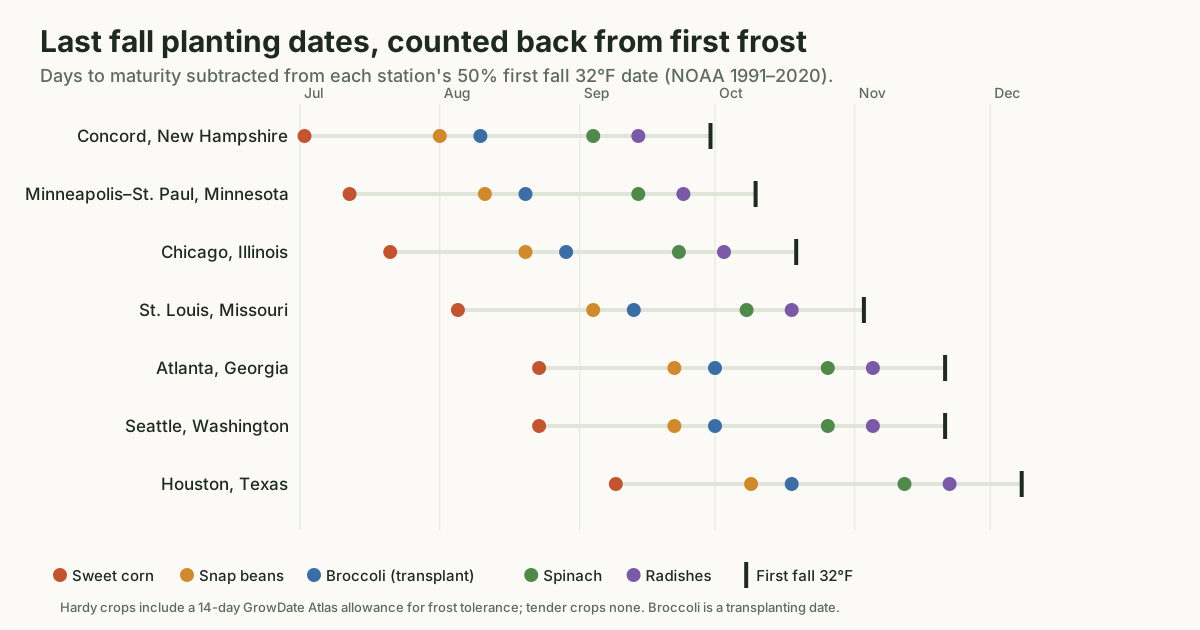
A fall planting calendar comes down to one subtraction: take your first fall frost date and count backward by each crop's days to maturity. Whatever date you land on is the last day that crop can go in and still finish before frost. Everything else on a fall calendar is a refinement of that rule.
This guide sets out the rule, shows where it comes from, works it through for seven cities, and is honest about the two places where the sources disagree and the site has had to choose. The method follows Purdue Extension's The Fall Vegetable Garden (HO-66-W). Days to maturity come from Colorado State University Extension's Vegetable Planting Guide, GardenNotes #720. Frost dates are the NOAA 1991–2020 normals for the station named on each city planting calendar.
The count-back rule for a fall planting calendar
Purdue's guide gives the method in three steps. Find the average date of the first killing frost for your area. Look up the days to maturity for the variety you want to grow. Count backward from the frost date by that many days. The date you reach is, in Purdue's words, the last feasible planting date.
That is the whole rule. It has two inputs, and each one has a source:
- The first fall frost date. This site uses the NOAA 1991–2020 50% probability date of the first fall minimum at or below 32°F for the station. Purdue says "average date of first killing frost" and does not name a probability level, so reading it as the 50% date is an editorial mapping on this site. The frost date probability guide explains what that 50% means.
- Days to maturity. This site uses the typical days to harvest in GardenNotes #720. For crops that are normally transplanted, such as broccoli and cabbage, the guide counts from transplanting, so the count-back gives a transplant date, not a sowing date.
Purdue also recommends choosing fast-maturing varieties for fall where you can, so the crop is harvested before the killing frost. That follows directly from the arithmetic: a variety that matures 20 days sooner can go in 20 days later.
What the rule does not add
Purdue's method does not add extra days for slower growth in the cooler, shorter days of fall, or for a harvest period after the crop first matures. Some fall-garden charts add a buffer for one or both. This site does not, because the source it follows does not, and adding an unsourced number would break the site's rule that every figure traces to a record.
The practical effect is that the count-back date is the latest date, not the ideal one. A crop planted on it reaches its listed days to maturity on the frost date itself, with nothing to spare. If a fall turns cool early, or your variety runs slower than the typical figure, the crop will not quite make it. Planting a week or two ahead of the last date gives the margin the rule does not.
Frost tolerance changes the deadline
A tender crop and a hardy crop do not face the same deadline, and Purdue's guide is the reason this calendar treats them differently. It sorts fall crops into three groups:
| Purdue group | What frost does to it | Examples from Purdue's table |
|---|---|---|
| Tender | Damaged by a light frost | Beans, cucumber, eggplant, muskmelon, pepper, squash, sweet corn, tomato, watermelon |
| Semi-hardy | Tolerates a light frost | Beets, carrot, cauliflower, chard, lettuce, parsnip, potato, spinach, turnip |
| Hardy | Tolerates a hard frost | Broccoli, Brussels sprouts, cabbage, collards, kale, kohlrabi, onion, peas, radish |
For tender crops the frost date is a hard stop: the crop has to be mature before it, so the last planting date is the frost date minus the full days to maturity. For hardy crops, Purdue notes that some are hardy enough to withstand several hard frosts, so they can still be growing after the first 32°F night.
This site turns that into a fixed allowance: 14 days for hardy crops and 7 for semi-hardy crops, added back to the count-back date. Those two numbers are GrowDate Atlas's own assumption. Purdue does not publish them, and neither does any other source the site uses. They are labelled as an assumption on every city page and on the methodology page, and you should treat them as a starting point rather than a rule.
Where the two extension guides disagree
There is a wrinkle worth knowing about. This site's crop classes come from Colorado State's GardenNotes #720, because that is the guide that also supplies the spring rules and the days to maturity. For most crops, Colorado State and Purdue put the crop in the same group. For three they do not:
| Crop | Colorado State #720 | Purdue HO-66-W | Effect on this site's fall date |
|---|---|---|---|
| Spinach | Hardy | Semi-hardy | Gets the 14-day allowance rather than 7 |
| Turnips | Hardy | Semi-hardy | Gets the 14-day allowance rather than 7 |
| Leaf lettuce | Hardy | Semi-hardy | Gets the 14-day allowance rather than 7 |
So for spinach, turnips and leaf lettuce, the last fall date on this site is one week later than it would be under Purdue's grouping. If you want the more cautious reading, take a week off those three dates. Colorado State also splits Purdue's single tender group into tender and very tender for spring planting; in fall, both get no allowance, so that split makes no difference to these dates.
Last fall planting dates for seven cities
Here is the rule applied to seven stations, from the shortest season on this site to one of the longest. Every date is the station's 50% first fall 32°F date minus the crop's days to maturity from GardenNotes #720, plus the site's allowance for hardy and semi-hardy crops. The same numbers appear in the fall column of each city's page.
| Crop (class) | Concord, NH | Minneapolis, MN | Chicago, IL | St. Louis, MO | Atlanta, GA | Seattle, WA | Houston, TX |
|---|---|---|---|---|---|---|---|
| First fall 32°F | Sep 30 | Oct 10 | Oct 19 | Nov 3 | Nov 21 | Nov 21 | Dec 8 |
| Sweet corn (tender, 60–90 days) | Jul 2 | Jul 12 | Jul 21 | Aug 5 | Aug 23 | Aug 23 | Sep 9 |
| Snap beans (tender, 60 days) | Aug 1 | Aug 11 | Aug 20 | Sep 4 | Sep 22 | Sep 22 | Oct 9 |
| Broccoli (hardy, 65 days from transplant) | Aug 10 | Aug 20 | Aug 29 | Sep 13 | Oct 1 | Oct 1 | Oct 18 |
| Beets (semi-hardy, 60 days) | Aug 8 | Aug 18 | Aug 27 | Sep 11 | Sep 29 | Sep 29 | Oct 16 |
| Leaf lettuce (hardy, 60 days) | Aug 15 | Aug 25 | Sep 3 | Sep 18 | Oct 6 | Oct 6 | Oct 23 |
| Spinach (hardy, 40 days) | Sep 4 | Sep 14 | Sep 23 | Oct 8 | Oct 26 | Oct 26 | Nov 12 |
| Radishes (hardy, 30 days) | Sep 14 | Sep 24 | Oct 3 | Oct 18 | Nov 5 | Nov 5 | Nov 22 |
Sweet corn uses the long end of its 60-to-90-day range, so its date is the conservative one. A 60-day variety could go in a month later.
Three things stand out.
The order of crops never changes. Sweet corn is always first and radishes are always last, in every city. That is because the gaps between crops come only from days to maturity and the allowance, which are the same everywhere. Moving north or south slides the whole column earlier or later; it does not reshuffle it.
The spread between cities is large. Radishes can go in until mid-September in Concord and until late November in Houston, a gap of more than two months, and that gap is exactly the gap between the two stations' first frost dates.
Seattle and Atlanta are identical. Both stations have a 50% first fall 32°F date of November 21, so every count-back date matches. That is a fair illustration of what the rule can and cannot see. It knows the frost date and the crop. It knows nothing about late-summer heat, rainfall or day length, and a fall garden in the two cities will behave differently for reasons the frost date does not capture.
The hard freeze matters for hardy crops
The first fall 32°F date is the right deadline for tender crops. For hardy crops that can ride through a light freeze, the next date that matters is the first hard freeze. NC State Extension defines a hard freeze as air below 28°F, and NOAA publishes the 50% first fall 28°F date for the same stations.
| Station | First fall 32°F | First fall 28°F | Gap |
|---|---|---|---|
| Concord, NH | Sep 30 | Oct 8 | 8 days |
| Minneapolis, MN | Oct 10 | Oct 22 | 12 days |
| Chicago, IL | Oct 19 | Oct 30 | 11 days |
| St. Louis, MO | Nov 3 | Nov 13 | 10 days |
| Atlanta, GA | Nov 21 | Dec 5 | 14 days |
| Seattle, WA | Nov 21 | Dec 9 | 18 days |
| Houston, TX | Dec 8 | Dec 26 | 18 days |
The site's 14-day allowance means a hardy crop planted on its last date reaches its days to maturity 14 days after the first fall 32°F date. Compare that with the gaps above. In Seattle and Houston, where the hard freeze typically comes 18 days after the first freeze, the crop finishes before the median first hard freeze. In Atlanta the two land on the same day. In Concord, Minneapolis, Chicago and St. Louis, where the gap is 8 to 12 days, the allowance runs past the 50% hard-freeze date.
That does not mean the crop will fail. Purdue says some hardy crops withstand several hard frosts. But it does mean gardeners in the colder interior cities are leaning on that tolerance more than gardeners on the Gulf or Pacific coasts. Where the gap between your 32°F and 28°F dates is short, plant hardy crops earlier rather than on the last date.
Using the fall calendar for your own garden
The seven cities above are examples. To get dates for your own place:
- Open your nearest station. Every city planting calendar has a "Last fall planting" column computed exactly as above, for all 27 crops.
- Or type your own frost date. The planting calendar tool accepts any pair of frost dates and applies the same rule. It also has a control to shorten the season at both ends if your garden frosts earlier than the station.
- Check the variety, not just the crop. The table uses the typical days to maturity from GardenNotes #720. Your seed packet gives the figure for your actual variety. If it is shorter, your last date moves later by the difference; if longer, earlier.
- Count transplants back from transplanting. For broccoli and cabbage, the date is when the plant goes into the ground. Start the seed earlier by however long you grow the transplant; the seed-starting guide covers the spring side of that arithmetic.
- Treat the date as a deadline. Purdue's method adds nothing for slower fall growth. Planting a week or two before the last date buys back the margin the rule leaves out.
What this calendar does not tell you
It is a timing tool, built on two published numbers and one labelled assumption. It does not say anything about soil preparation, watering a seedbed through late-summer heat, or pest pressure in fall, because none of the sources it uses covers those, and the site does not state figures it cannot trace. It also cannot tell you about this particular fall. A 50% frost date is the middle of 30 years of records; in about half of years the first freeze comes earlier.
What it does give you is the one number most fall gardens are missed by: the last day a crop can go in and still finish. Count back from your first frost date, give hardy crops a little grace, plant ahead of the deadline rather than on it, and the fall planting calendar does the rest.
Sources
- B. Rosie Lerner, The Fall Vegetable Garden, Purdue Extension HO-66-W, reviewed September 2019. Count-back method, last feasible planting date, frost tolerance groups.
- Colorado State University Extension, Vegetable Planting Guide, CMG GardenNotes #720, reviewed September 2024. Crop classes and typical days to harvest.
- NOAA National Centers for Environmental Information, U.S. Climate Normals 1991–2020, 50% probability first fall 32°F and 28°F dates. Retrieved October 16, 2026.
- Nelson, El-Khoury and Boyette, Interpreting Freeze / Frost Probabilities from the National Centers for Environmental Information, NC State Extension AG-873, revised December 11, 2024. Definition of a hard freeze.
Frequently asked questions
How do I work out the last date to plant for a fall harvest?
Find your average first fall frost date, then count backward by the crop's days to maturity. Purdue Extension's fall garden guide calls the result the last feasible planting date. On this site the frost date is the NOAA 1991–2020 50% probability first fall 32°F date for your station, and days to maturity come from Colorado State Extension GardenNotes #720.
Can hardy crops be planted later than the count-back date?
A little. Purdue Extension says some fall crops are hardy enough to withstand several hard frosts, so they do not need to be fully mature by the first 32°F night. This site gives hardy crops 14 extra days and semi-hardy crops 7. Those allowances are GrowDate Atlas's own editorial assumption, not a figure from Purdue or any other source, and every city page labels them that way.
Why are Seattle's and Atlanta's fall planting dates identical?
Because both stations have the same 50% first fall 32°F date, November 21. The count-back rule only looks at the frost date and the crop's days to maturity, so two cities with the same frost date get the same last planting dates. The rule says nothing about late-summer heat, rainfall or day length, which differ a great deal between the two.
Do broccoli and cabbage dates mean sowing or transplanting?
Transplanting. Colorado State Extension counts days to harvest for broccoli and cabbage from transplanting, so the count-back lands on the date the plant goes into the ground. The seed has to be started earlier, indoors or in a seedbed, by however long you grow the transplant.
Is the first frost date the date to stop planting tender crops?
No. It is the date the crop must already be finished by. Purdue Extension classes beans, cucumbers, squash, sweet corn and tomatoes as tender, damaged by a light frost, so a tender crop has to reach maturity before the first frost. The last planting date for it is the frost date minus its full days to maturity, with no allowance.