Succession Planting Calendar: Intervals and Cutoff Dates
A succession planting calendar is an interval plus two dates: first sowing and last sowing. Extension intervals and NOAA frost dates for 4 cities.
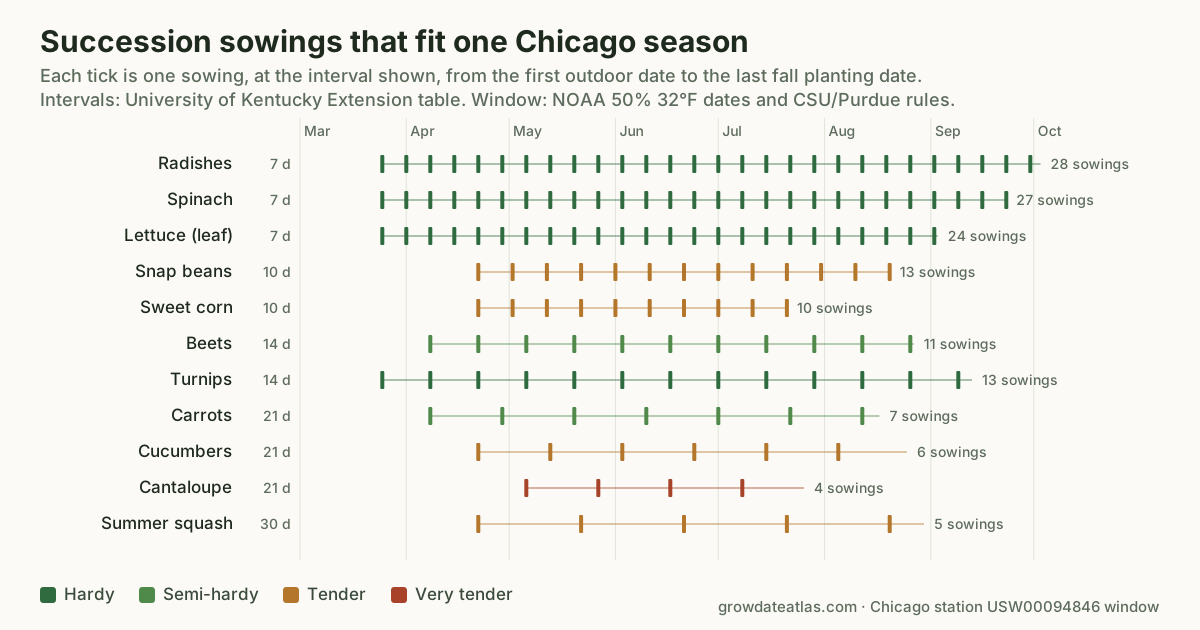
A succession planting calendar is three numbers per crop: the interval between sowings, the first date you can sow, and the last date a sowing can still mature before frost. Extension services publish the interval. Your frost dates set the other two. Put them together and Chicago gets 13 sowings of snap beans at 10-day intervals, from April 22 to August 20, while Concord, New Hampshire gets 9.
This guide builds that calendar from published sources: sowing intervals from University of Kentucky, Missouri, Georgia and Cornell extension pages, first and last sowing dates from the same NOAA 1991–2020 frost dates and Colorado State and Purdue rules behind every city planting calendar on this site. Every interval below is quoted from a named source, and every date is arithmetic on a named weather station.
What succession planting is
Succession planting means sowing the same crop again at intervals so that a new batch matures as the last one finishes. University of Georgia Extension's Alicia Holloway describes it simply as planting vegetables continuously throughout the season. The aim is a steady harvest of lettuce or beans rather than one glut and then nothing.
University of Missouri Extension horticulturist Marlin Bates gives two reasons to bother. Planting every other week, he says, lets gardeners maximise the productivity of their beds. And the extra effort spreads the risk of crop failure: one bad sowing does not cost the season.
There is a second meaning of the term, where a different crop follows the first in the same bed. Missouri's advice touches on that too: rows past their peak can be pulled to make room for other crops. This guide covers both, but the calendar arithmetic is the same either way. Every sowing still needs a start date and a cutoff.
Succession planting intervals by crop
The most specific interval table among the extension pages consulted is one University of Kentucky Extension horticulture agent Beth Wilson publishes on succession planting, which credits Johnny's Seeds as its source:
| Interval | Crops |
|---|---|
| Every 7 days | Leaf or baby lettuce, radish, spinach, cilantro |
| Every 10 days | Sweet corn, bush beans, head lettuce |
| Every 14 days | Beets, turnips, parsley, basil, dill |
| Every 21 days | Cucumbers, melons, carrots |
| Every 30 days | Summer squash |
Other extension services round these to a single figure:
- University of Georgia Extension: two weeks is a good planting interval for most crops.
- University of Missouri Extension: radish, carrot, beet, kohlrabi, sweet corn and turnip every couple of weeks; cucumber, bush beans, broccoli, cabbage and lettuce in new rows at 14-day intervals.
- Cornell Cooperative Extension, St. Lawrence County: succession planting is normally done on a two- to three-week interval.
The sources agree on the shape and differ on the detail. Fast, short-lived crops get the shortest gaps. Crops that produce over several weeks, such as cucumbers and squash, get the longest. Where the Kentucky table and Missouri disagree, as they do on lettuce, the difference is about harvest size rather than right and wrong: a 7-day gap gives small weekly cuttings, a 14-day gap gives fewer, larger ones.
The first sowing: your spring planting date
A succession starts on the crop's first safe outdoor date. On this site that date comes from Colorado State University Extension's Vegetable Planting Guide, which sets outdoor planting relative to the average last spring frost by frost class:
| Frost class | First outdoor sowing | Crops in the table above |
|---|---|---|
| Hardy | 2–4 weeks before the last spring frost | Radishes, spinach, leaf lettuce, turnips |
| Semi-hardy | 0–2 weeks before the last spring frost | Beets, carrots |
| Tender | Around the last spring frost | Snap beans, sweet corn, cucumbers, summer squash |
| Very tender | 2+ weeks after the last spring frost | Cantaloupe, watermelon |
So a hardy crop's succession can begin four weeks before the last frost, and a very tender crop's cannot begin until two weeks after it. That six-week head start is why radishes get so many more sowings than melons in every city.
The last sowing: your fall cutoff date
A succession ends when a new sowing no longer has time to mature. The method comes from Purdue Extension's HO-66-W, The Fall Vegetable Garden: count the crop's days to maturity back from the first fall frost. That is the last practical sowing.
On the city pages, hardy crops get 14 extra days and semi-hardy crops 7 on top of Purdue's count, because they tolerate frost and can finish after it. Those two figures are an editorial assumption of this site, not a number from either source, and the methodology page says so. The fall planting guide works the cutoff through crop by crop.
None of the extension succession pages consulted gives a stop date. Georgia points to days to maturity on the seed packet; Missouri gives no end date at all. The frost count-back fills that gap, and it is the part a city's own data can answer.
A succession planting calendar for Chicago
Put the interval, the first sowing and the cutoff together for one station. Chicago's NOAA station has a 50% last spring 32°F date of April 22 and a first fall 32°F date of October 19, a 180-day season.
| Crop | Interval | First sowing | Last sowing | Sowings that fit |
|---|---|---|---|---|
| Radishes | 7 days | Mar 25 | Oct 3 | 28 |
| Spinach | 7 days | Mar 25 | Sep 23 | 27 |
| Leaf lettuce | 7 days | Mar 25 | Sep 3 | 24 |
| Snap beans | 10 days | Apr 22 | Aug 20 | 13 |
| Sweet corn | 10 days | Apr 22 | Jul 21 | 10 |
| Beets | 14 days | Apr 8 | Aug 27 | 11 |
| Turnips | 14 days | Mar 25 | Sep 13 | 13 |
| Carrots | 21 days | Apr 8 | Aug 17 | 7 |
| Cucumbers | 21 days | Apr 22 | Aug 25 | 6 |
| Cantaloupe | 21 days | May 6 | Jul 26 | 4 |
| Summer squash | 30 days | Apr 22 | Aug 30 | 5 |
"Sowings that fit" is the days between the first and last sowing divided by the interval, plus one. The chart at the top of this page draws each sowing as a tick.
Read the table as a ceiling, not a plan. Nobody needs 28 radish sowings. What it tells you is the window: radishes and spinach can be sown in Chicago from late March into the autumn, while cantaloupe has an 81-day window that fits four sowings at three-week gaps.
Midsummer sowings of cool-season crops
The spinach and lettuce rows run straight through July. In practice, cool-season crops stall in the heat. Colorado State's guide notes that cool-season vegetables prefer 60°F to 80°F and lose quality in hot weather, and that they are often planted in early spring and replanted in midsummer for fall harvest. Its germination tables give a maximum soil temperature of 70°F for spinach, peas and leaf lettuce. Nebraska Extension adds that lettuce, peas and spinach germinate poorly in soil above 85°F.
So the realistic Chicago spinach calendar is two blocks: weekly sowings from late March into late spring, a summer gap, then weekly sowings again from late summer to the September 23 cutoff. Cornell's St. Lawrence County calendar describes the same pattern, with cool-season outdoor seeding resuming toward the end of July as nights cool.
How the calendar changes by city
The intervals are the same everywhere. The window is not. Here is snap beans at 10-day intervals and leaf lettuce at 7-day intervals across four stations:
| City | Season (32°F, 50%) | Snap beans window | Bean sowings | Leaf lettuce window | Lettuce sowings |
|---|---|---|---|---|---|
| Concord, NH | 140 days | May 13 – Aug 1 | 9 | Apr 15 – Aug 15 | 18 |
| Chicago, IL | 180 days | Apr 22 – Aug 20 | 13 | Mar 25 – Sep 3 | 24 |
| Atlanta, GA | 246 days | Mar 20 – Sep 22 | 19 | Feb 20 – Oct 6 | 33 |
| Houston, TX | 293 days | Feb 18 – Oct 9 | 24 | Jan 21 – Oct 23 | 40 |
Houston can fit nearly three times as many bean sowings as Concord. But the Houston figure carries the biggest caveat on the page: the frost rules do not model heat. The methodology page flags Houston as a station where the limit on summer crops is heat, not frost, so a Houston calendar has a midsummer gap for many crops that the arithmetic does not show.
Sweet corn shows the same squeeze from a different angle. Colorado State gives it 60 to 90 days to harvest, and the site counts the cutoff from the long end of that range. In Concord that leaves a window from May 13 to July 2, which fits 6 sowings at 10-day intervals. In Chicago the window runs to July 21 and fits 10. A shorter-season variety moves the cutoff later; University of Kentucky Extension's advice is to choose varieties by days to maturity and by heat or cold tolerance, using heat-tolerant ones for summer harvests. Choosing an early variety for the last sowing is the one honest way to stretch a succession past the dates in the table.
Crops that do not need succession planting
Missouri Extension's advice is that fruiting vegetables can be planted all at once, because they produce throughout the season. Bates's examples of crops that do benefit are the opposite kind: radish, carrot, beet, kohlrabi, sweet corn and turnip, plus cucumber, bush beans, broccoli, cabbage and lettuce. Missouri also notes that cucumbers and bush beans drop off significantly after about two weeks of high productivity, which is why they reward a second and third sowing.
Tomatoes and peppers sit in between. University of Kentucky Extension describes two to four plantings for central Kentucky, roughly a month apart, with the last safe planting date there given as June 15 to July 1 and a later one possible with a short-season variety and cold protection. That is a regional schedule from one extension office, and it is worth reading as an example of the method rather than as dates to copy.
In short-season cities, the arithmetic usually decides for you. In Concord, tomatoes have a 140-day season and a 65-day maturity counted from transplanting, with the transplant window running from May 27 to June 10. A second planting a month later would be transplanted in early July and need to finish before the September 30 first fall frost, which leaves very little margin.
Building your own succession planting calendar
Five steps, using your city page or your own frost dates:
- Find your two frost dates. Your city planting calendar lists the 50% last spring and first fall 32°F dates for its station. If you know your own dates, the planner tool takes them directly.
- Read each crop's first outdoor date from the planting table. That is your first sowing.
- Read each crop's last fall planting date from the same table. That is your last sowing.
- Pick an interval from the table above, or use two weeks if your crop is not listed.
- Count the sowings. Days between first and last, divided by the interval, plus one. Then cut out the midsummer sowings of cool-season crops if your summers are hot.
The planner tool exports every crop's windows as a CSV, which is the quickest way to lay the calendar out in a spreadsheet. If your garden frosts earlier or later than the station, its microclimate control shortens the season at both ends by the number of days you choose, and every first and last sowing moves with it.
What this calendar does not tell you
It does not tell you how much to sow at once. That depends on how much your household eats, which no extension table can know. It does not account for heat, which ends many cool-season crops long before the frost cutoff. And the intervals are guidance from named extension pages, not measurements from this site; nobody here has tested a sowing schedule.
What it does tell you is the part most succession advice skips: when the season opens and closes for each crop at your station. The interval is the easy part. The window is what makes a succession planting calendar fit your city.
Sources
- Beth Wilson, Succession Planting, University of Kentucky Cooperative Extension (Franklin County office), interval table credited to Johnny's Seeds. Retrieved 2026-10-17.
- University of Missouri Extension, Get into a two-week planting schedule, quoting horticulturist Marlin Bates. Retrieved 2026-10-17.
- Alicia Holloway, Succession planting for an extended harvest, University of Georgia CAES Field Report, April 19, 2018. Retrieved 2026-10-17.
- Ken Kogut, A Succession Planting Calendar for St. Lawrence County, Cornell Cooperative Extension of St. Lawrence County, June 23, 2021. Retrieved 2026-10-17.
- Colorado State University Extension, Vegetable Planting Guide, CMG GardenNotes #720, reviewed September 2024. Retrieved 2026-10-17.
- Purdue Extension, The Fall Vegetable Garden, HO-66-W, reviewed September 2019. Retrieved 2026-10-17.
- NOAA/NCEI U.S. Climate Normals 1991–2020, 50% probability last spring and first fall 32°F dates. Retrieved 2026-10-16.
Frequently asked questions
How often should I succession plant lettuce?
Every 7 days for leaf or baby lettuce and every 10 days for head lettuce, in the interval table University of Kentucky Extension publishes from Johnny's Seeds. University of Missouri Extension suggests 14-day intervals for lettuce instead. A shorter interval means smaller, more frequent harvests; a longer one means fewer, larger ones.
When should I stop succession planting?
At each crop's last fall planting date: the days to harvest counted back from your first fall 32°F date. In Chicago that is August 20 for snap beans, September 3 for leaf lettuce and October 3 for radishes. A sowing after that date is likely to be caught by frost before it matures.
Which vegetables should not be succession planted?
Long-season fruiting crops that keep producing once they start. University of Missouri Extension says fruiting vegetables can be planted all at once because they produce through the season. Tomatoes, peppers and eggplant usually fall in that group, although University of Kentucky Extension describes two to four staggered tomato and pepper plantings for central Kentucky.
How many succession plantings can I fit in one season?
Divide the days between the first outdoor date and the last fall planting date by the interval, then add one. Snap beans in Chicago run from April 22 to August 20, 120 days, so 10-day sowings give 13 plantings. In Concord, New Hampshire, the same crop runs May 13 to August 1, 80 days, which gives 9.
Is two weeks a good default interval?
Yes, for most crops. University of Georgia Extension calls two weeks a good planting interval for most crops, Cornell Cooperative Extension in St. Lawrence County describes two to three weeks as normal, and University of Missouri Extension suggests every other week. Fast crops such as radishes and spinach can go shorter.