How to Protect Plants From Frost: Covers That Work
How to protect plants from frost: row covers, blankets, cold frames and water walls, with the degrees each buys from Colorado State Extension trials.
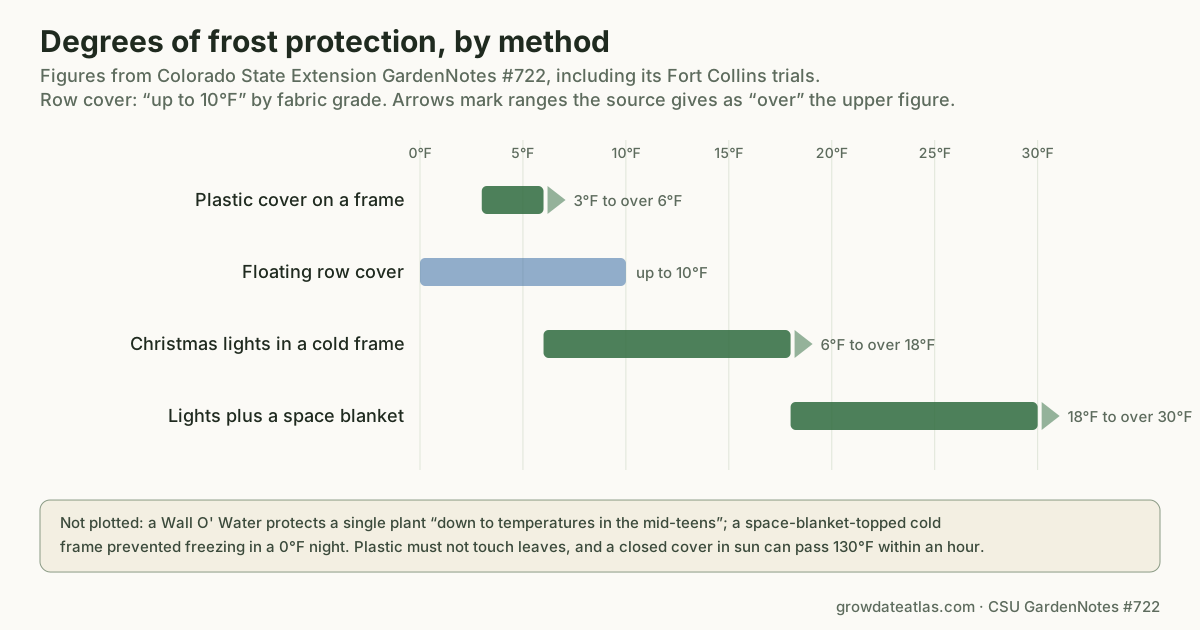
How to protect plants from frost depends on how cold the night will get and what kind of frost it is. A floating row cover buys up to 10°F; plastic on a frame buys 3°F to over 6°F; a water-filled plant protector holds a single plant down to the mid-teens. Those figures come from Colorado State University Extension's GardenNotes #722, which also explains the one distinction that decides whether covering is worth it at all: a calm, clear-night frost can be beaten, and a cold front often cannot.
This guide sets out the methods and the degrees each one buys, quoted from Colorado State, Purdue and Nebraska extension publications, and shows when in the season to use them, using the NOAA 1991–2020 frost dates on every city planting calendar. The protection figures are extension trial results. Nobody at this site has tested a cover.
Two kinds of frost, and which one you can stop
Colorado State's Frost Protection and Extending the Growing Season (GardenNotes #722) separates frosts by how they arrive:
| Type | How it happens | Can covers help? |
|---|---|---|
| Radiation frost | Calm, clear nights with no cloud cover to hold heat in | Yes. Early and late in the season these are typically only a few degrees below critical |
| Advective frost | A cold front moves into the area | Often not. Temperatures may drop well below critical, making protection questionable |
That is the most useful fact in frost protection. Most of the frosts that catch gardeners at the edges of the season are radiation frosts: a still, starry night after a mild day. Heat leaves the ground and the plants and escapes to a clear sky. A cover traps some of that heat near the plant, and a few degrees is often all it takes.
An advective freeze is different. Cold air arrives in bulk and keeps falling. A row cover rated for a few degrees will not save tomatoes from a night in the low 20s.
NC State Extension adds a point that explains why plants can be frosted on nights the forecast says will stay above freezing. In its guide to interpreting NOAA freeze and frost probabilities, it notes that frost depends on humidity as well as temperature, that no single temperature defines it, and that a freeze can happen without frost and frost without a freeze. It uses 36°F as the threshold where frost risk rises. On a clear night a leaf can sit colder than the air at the thermometer.
How to protect plants from frost: the methods
GardenNotes #722 gives figures for each method, several of them from trials in Fort Collins:
| Method | Protection | Notes from the source |
|---|---|---|
| Floating row cover | Up to 10°F, by fabric and grade | Lies directly on crops; also cuts wind and screens some insects |
| Plastic on a frame | 3°F to over 6°F | Must be held off the plants; added 2 to 6+ weeks at each end of the season |
| Blankets and sheets | Not quantified | Work while dry; wet fabric can make it colder |
| Wall O' Water | Down to the mid-teens | Water-filled ring around one plant; also blocks wind |
| Cold frame with Christmas lights | 6°F to over 18°F | One 25-light C-7 string per 4-by-5-foot frame, on at dusk, off at dawn |
| Lights plus a space blanket | 18°F to over 30°F | Space blanket laid aluminised side down over the plastic |
The chart at the top of this page draws those ranges. Two of them come with conditions that matter more than the numbers.
Row covers
A floating row cover is a lightweight fabric laid straight over the crop. Colorado State says it gives up to 10°F of frost protection depending on the material and grade, cuts wind and screens some insects. It can stay on for long periods. The catch is pollination: covers must come off insect-pollinated crops, such as squash, cucumbers and melons, once they flower.
Plastic covers
Plastic works only when it is held up. Colorado State says covers need to be held off the plants to prevent them freezing where they touch the cover. Hoops set 3 to 5 feet apart, depending on wind exposure, hold plastic or fabric into a low tunnel.
Plastic also overheats. The same guide says the covering must be opened, at least a slit, during the day, and that with just an hour of sun the temperature under a closed cover can rise past 130°F. A plastic tunnel that saves plants at night can cook them by noon.
Blankets, sheets and caps
Household covers are the quickest fix for a single cold night. Purdue Extension's The Fall Vegetable Garden suggests covering beds with blankets or throw-cloths supported by stakes or wire, and protecting single plants with paper caps, milk jugs or plastic water-holding walls. Nebraska Extension's Fall Vegetable Gardening gives the routine: cover tender plants on frost nights and uncover them once temperatures rise above 32°F.
Colorado State adds two warnings. Blankets work while dry, but if the fabric absorbs water, evaporative cooling can lead to colder temperatures next to it. And they should come off in the daytime, so the soil can recharge its stored heat for the next night.
Water walls
A Wall O' Water is a ring of water-filled plastic tubes around one plant. Colorado State explains that it works on the heat released when water freezes, and that it protects down to temperatures in the mid-teens while also sheltering the plant from wind. The limit is size: plants can outgrow it and then be nipped by frost. Colorado State pairs it with black plastic mulch to warm the soil, because cold soil limits early production.
When to protect plants: your frost dates
Frost protection is a tool for the ends of the season, and your station's frost dates tell you where those ends are.
The dates on each city page are 50% dates. In half of the springs from 1991 to 2020, a 32°F night came after the last spring date; in half of the autumns, one came before the first fall date. Purdue's frost map makes the fall side concrete: it notes a 50% chance of frost on the average first frost date, and a 10% chance of a 32°F reading two weeks before it. The last frost date probability guide explains the probabilities in full.
So covers earn their keep in two windows:
| Window | What is at risk | Example: Chicago, IL |
|---|---|---|
| Spring, around the last 32°F date | Hardy and semi-hardy crops already out; early tender plantings | Last spring 32°F: Apr 22; last 28°F: Apr 11 |
| Fall, around the first 32°F date | Tender crops still producing | First fall 32°F: Oct 19; first 28°F: Oct 30 |
The gap between the 32°F and 28°F dates is the stretch where light freezes are common and hard freezes are not. That is exactly the range a row cover's few degrees can bridge. In Chicago it is 11 days at each end of the season. In Portland, Oregon the spring gap is 28 days, from February 16 to March 16, so a cover can let hardy crops go out much earlier relative to tender ones.
Spring frost protection
In spring, covers let you plant earlier than the calendar would otherwise allow, or protect an early planting from a late frost.
Hardy crops such as broccoli, cabbage, peas and spinach already go out two to four weeks before the last frost under Colorado State's planting rules. A row cover over them at night is insurance against a late radiation frost. Colorado State's Fort Collins trials found plastic covers on frames added two to six weeks or more to both ends of the season.
Very tender crops are a different case. Colorado State says they need daytime temperatures above 60°F and are intolerant of cool spring winds as well as frost. A water wall or a tunnel can protect a tomato transplant from frost; it cannot make a cold, windy spring warm enough for it to grow well. The calendars on this site keep very tender transplants two to four weeks after the last frost date even if you have covers, and the hardening off guide covers getting them ready for that date.
Fall frost protection
In fall, protection can win back weeks. Purdue notes that tender crops can be protected through early light frosts, and that Indiana often has several more weeks of good growing weather after the first frost. Nebraska says the same of its own state: the first frost is often followed by two to three weeks of warmer weather.
That makes the first fall frost worth fighting for, especially for tomatoes, peppers and beans still loaded with fruit. A blanket or row cover on the first few clear, cold nights can carry them into a mild spell that adds real harvest. The fall planting calendar gives the last sowing date for each crop; protection is what lets the crops you have already planted finish.
Hardy crops need less help. Purdue groups broccoli, Brussels sprouts, cabbage, collards, kale, kohlrabi and peas as hardy, tolerating hard frost. Nebraska says root crops such as beets, carrots, parsnips and turnips can stay in the ground through fall, and after hard freezes can be mulched under a heavy layer of straw and dug as needed. For those crops, the 28°F date matters more than the 32°F one.
Cold frames for season extension
A cold frame is a low box with a transparent lid. Colorado State describes one built from concrete mesh and 4-mil plastic, opened on warm days and closed on cold nights. Its management rules are specific:
- Open it on warm days.
- Close it on freezing nights.
- Leave it open a crack on warm nights, and open the top a crack on cool days.
- Keep it closed on stormy days with full cloud and no direct sun.
Add a string of old-style C-7 Christmas lights and the Fort Collins trials gave 6°F to over 18°F of protection; add a space blanket on top on the coldest nights and that rose to 18°F to over 30°F. A space-blanket-topped cold frame in those trials prevented freezing when the outside temperature fell to 0°F. That is no longer frost protection in the ordinary sense; it is winter growing, and the same source says to remove the space blanket each day.
Cold frames double as a place to harden off seedlings in spring, which is how Nebraska and Maryland extension services both describe using them.
What frost protection cannot do
Covers move the odds by a few degrees. They do not change the climate your station describes. A cover rated for a few degrees will not save tender crops from a hard advective freeze, and no amount of protection makes a 140-day season into a 200-day one.
That is why the planting dates on this site do not assume protection. They are built from the frost dates and extension rules alone, so you can see what the season allows and decide how much risk to take on top of it. If your garden sits in a frost pocket and you know it freezes later than the station, the planner tool can shorten the season at both ends by a number of days you choose. That number comes from your own experience, not from NOAA.
The short version
Most edge-of-season frosts are calm, clear-night radiation frosts, a few degrees below critical, and covers beat them. Floating row cover gives up to 10°F; plastic on hoops gives 3°F to over 6°F but must be held off the leaves and vented in sun; dry blankets work for a night and come off by day; a water wall holds one plant into the mid-teens. Cold fronts are harder and often cannot be covered against. Watch your station's 32°F and 28°F dates, cover tender crops on clear, still nights near them, and you will know how to protect plants from frost.
Sources
- David Whiting, Carol O'Meara and Carl Wilson, Frost Protection and Extending the Growing Season, Colorado State University Extension GardenNotes #722, published October 2014, reviewed May 2023. Retrieved 2026-10-17.
- B. Rosie Lerner, The Fall Vegetable Garden, Purdue Extension HO-66-W, reviewed September 2019. Retrieved 2026-10-17.
- David Lott and Dale Lindgren, Fall Vegetable Gardening, University of Nebraska–Lincoln Extension NebGuide G1343, revised March 2012. Retrieved 2026-10-17.
- Nelson, El-Khoury and Boyette, Interpreting Freeze / Frost Probabilities from the National Centers for Environmental Information, NC State Extension AG-873, revised December 11, 2024. Retrieved 2026-10-17.
- Colorado State University Extension, Vegetable Planting Guide, CMG GardenNotes #720, reviewed September 2024. Retrieved 2026-10-17.
- NOAA/NCEI U.S. Climate Normals 1991–2020, 50% probability spring and fall 32°F and 28°F dates for each station. Retrieved 2026-10-16.
Frequently asked questions
How many degrees does a row cover protect plants from frost?
Up to 10°F, depending on the fabric and its grade, according to Colorado State Extension GardenNotes #722. Lighter covers give less. Row covers can stay on for long periods, but must come off insect-pollinated crops such as squash and melons when they flower so they can be pollinated.
Should I cover plants with plastic for frost?
Only if the plastic is held off the leaves. Colorado State says covers must be held off plants to prevent them freezing where they touch the cover. In its Fort Collins trials, plastic on frames gave 3°F to over 6°F of protection. On sunny days the cover must be opened, because a closed cover can pass 130°F within an hour.
Do old sheets and blankets work for frost?
Yes, while they are dry. Colorado State warns that if the fabric absorbs water, evaporative cooling can make it colder next to the blanket. Purdue Extension suggests covering beds with blankets or throw-cloths supported by stakes or wire. Remove them in the daytime so the soil can take up heat again.
Which frosts can I protect against and which can I not?
Colorado State separates radiation frosts, on calm, clear nights, from advective frosts, when a cold front moves in. Radiation frosts early and late in the season are usually only a few degrees below critical, so covers are worthwhile. An advective freeze can drop well below critical temperatures, which makes protection questionable.
When should I start covering plants in fall?
Around your first fall 32°F date for tender crops. That is the 50% date, so half of autumns freeze earlier; Purdue Extension's frost map notes a 10% chance of a 32°F reading two weeks before it. Covering tender crops through one early frost can win extra weeks, since mild weather often follows the first frost.