Cool-Season vs Warm-Season Crops: When to Plant Each
Cool-season vs warm-season crops: what separates them, the soil temperature each needs, and their planting windows from NOAA frost dates in 4 cities.
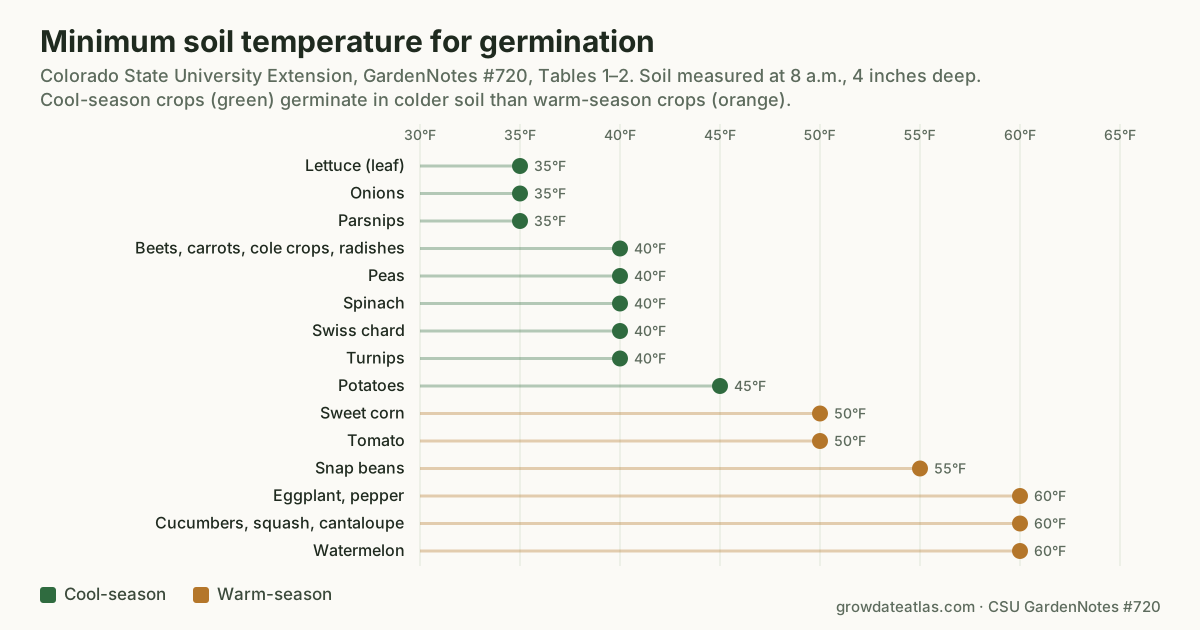
Cool-season vs warm-season crops is the first split in any planting calendar, and it decides which side of the last frost date a crop goes in. Cool-season crops prefer 60°F to 80°F, germinate in soil as cold as 35°F to 45°F, and go out from four weeks before the last spring frost. Warm-season crops prefer 70°F to 95°F, need soil of 50°F to 60°F, and go out on the frost date or two or more weeks after it. In Chicago, that puts peas in the ground from March 25 and tomatoes from May 6.
This guide sets out the difference using Colorado State University Extension's Vegetable Planting Guide, which defines both groups and publishes germination soil temperatures for each crop, and applies it to the NOAA 1991–2020 frost dates behind every city planting calendar. Every temperature below is quoted from that guide or from another named extension source. Every date is arithmetic on a named station.
Cool-season vs warm-season crops: the definitions
Colorado State's definitions are short:
| Cool-season | Warm-season | |
|---|---|---|
| Preferred growing temperature | 60°F to 80°F | 70°F to 95°F |
| In hot weather | Loses quality | Thrives |
| Frost | Hardy ones may survive a frosty nip | Intolerant of frost |
| Minimum germination soil temperature | 35°F to 45°F | 50°F to 60°F |
| Spring planting | 4 weeks before to the last frost date | The last frost date to 2+ weeks after |
| Second planting for fall | Common | Possible in long seasons |
The guide splits each group again by how much cold it takes. Cool-season crops are hardy or semi-hardy; warm-season crops are tender or very tender. Those four frost classes are what this site uses to set planting windows, so it is worth seeing what each one means in Colorado State's own words:
- Hardy vegetables grow with daytime temperatures as low as 40°F and may survive a frosty nip.
- Semi-hardy vegetables grow with minimum daytime temperatures of 40°F to 50°F and are less tolerant of a frosty night.
- Tender vegetables grow with a daytime temperature above 55°F and are intolerant of frost.
- Very tender vegetables are intolerant not only of frost but of cool spring winds, need daytime temperatures above 60°F, and may be stunted by a week below 55°F.
Which crops are cool-season and which are warm-season
Colorado State's crop groups, as used for the 27 crops on this site:
| Group | Frost class | Crops |
|---|---|---|
| Cool-season | Hardy | Broccoli, cabbage, kohlrabi, lettuce, onions, peas, radishes, spinach, turnips |
| Cool-season | Semi-hardy | Beets, carrots, cauliflower, parsnips, potatoes, Swiss chard |
| Warm-season | Tender | Snap beans, sweet corn, cucumbers, summer squash |
| Warm-season | Very tender | Cantaloupe, eggplant, peppers, tomatoes, winter squash, watermelon |
Other extension services do not draw every line in the same place. Purdue Extension's fall garden guide, for example, groups spinach and turnips as semi-hardy where Colorado State calls them hardy, and Nebraska Extension's fall guide calls carrots hardy where both of the others call them semi-hardy. The cool-versus-warm split is consistent across sources; the hardy-versus-semi-hardy line within it moves a little. This site follows Colorado State for every class.
Soil temperature: the better signal for planting
Colorado State says soil temperature is a key guide for spring planting: plant when the soil reaches the crop's minimum temperature, measured at 8 a.m. and 4 inches deep (6 inches for beans). Its germination tables give a minimum, an optimum and a maximum for each crop.
| Crop | Season | Minimum | Optimum | Maximum |
|---|---|---|---|---|
| Leaf lettuce | Cool | 35°F | 70°F | 70°F |
| Onions | Cool | 35°F | 80°F | 90°F |
| Parsnips | Cool | 35°F | 70°F | 90°F |
| Beets, broccoli, cabbage, carrots, cauliflower, kohlrabi, radishes | Cool | 40°F | 80°F | 90°F |
| Peas | Cool | 40°F | 70°F | 70°F |
| Spinach | Cool | 40°F | 70°F | 70°F |
| Swiss chard | Cool | 40°F | 85°F | 95°F |
| Turnips | Cool | 40°F | 80°F | 100°F |
| Potatoes | Cool | 45°F | — | — |
| Sweet corn | Warm | 50°F | 80°F | 100°F |
| Tomato | Warm | 50°F | 80°F | 100°F |
| Snap beans | Warm | 55°F | 80°F | 90°F |
| Eggplant, pepper | Warm | 60°F | 80°F | 90°F |
| Cantaloupe, cucumbers, summer and winter squash | Warm | 60°F | 90°F | 100°F |
| Watermelon | Warm | 60°F | 90°F | 110°F |
The minimums show the split more clearly than any calendar. No cool-season crop needs soil warmer than 45°F to germinate. No warm-season crop germinates below 50°F. The chart at the top of this page plots that gap.
The maximums matter too, and they are the less familiar half. Peas, spinach and leaf lettuce top out at 70°F. Colorado State says its maximum figures refer to high soil temperatures that may interfere with summer germination. That is why a midsummer sowing of spinach for fall can fail even when the calendar says it is in time.
This site does not publish soil temperatures for any city, because NOAA's freeze normals do not include them and the site states no number it cannot trace. A soil thermometer at 4 inches in your own bed is the only source for that reading. The frost date tells you when to start checking it.
Cool-season and warm-season planting windows by city
Colorado State sets outdoor planting relative to the average last spring frost. Applied to the 50% last spring 32°F date at four stations:
| Group | Rule | Concord, NH (May 13) | Chicago, IL (Apr 22) | St. Louis, MO (Apr 3) | Atlanta, GA (Mar 20) |
|---|---|---|---|---|---|
| Hardy | 4 to 2 weeks before frost | Apr 15 – Apr 29 | Mar 25 – Apr 8 | Mar 6 – Mar 20 | Feb 20 – Mar 6 |
| Semi-hardy | 2 weeks before to frost date | Apr 29 – May 13 | Apr 8 – Apr 22 | Mar 20 – Apr 3 | Mar 6 – Mar 20 |
| Tender | Frost date to 1 week after | May 13 – May 20 | Apr 22 – Apr 29 | Apr 3 – Apr 10 | Mar 20 – Mar 27 |
| Very tender | 2 to 4 weeks after frost | May 27 – Jun 10 | May 6 – May 20 | Apr 17 – May 1 | Apr 3 – Apr 17 |
Two editorial choices sit in that table and are stated on the methodology page. Colorado State's "around the date of the average last spring frost" for tender crops is rendered as the frost date to one week after. Its "2+ weeks after" for very tender crops is rendered as two to four weeks after. The guide does not name a probability level for "average last spring frost", and the site reads it as the 50% date at 32°F.
Within any one city, the gap from the first hardy sowing to the first very tender transplant is six weeks. In Chicago, peas and spinach can go in on March 25 and tomatoes not until May 6. That six-week spread is the practical meaning of the cool-season vs warm-season split: two separate planting seasons in spring, not one.
Why warm-season crops wait past the frost date
The very tender rule, two or more weeks after the last frost, surprises people who think of the frost date as the start of planting. There are two reasons for it, and both are in the definitions.
The first is probability. The 50% frost date is the middle of the record: in half of springs from 1991 to 2020, a 32°F night came later. Waiting two weeks puts a frost-intolerant crop well past that midpoint. The last frost date probability guide covers that in detail.
The second is warmth rather than frost. Colorado State says very tender crops need daytime temperatures above 60°F, are intolerant of cool spring winds, and can be stunted by a week below 55°F. Its guide adds that very tender crops need weather consistently above 55°F in the daytime, and that breezes should have lost any cool nip. A tomato planted on a frost-free but chilly day may survive and still sit unmoving for weeks. The soil table says the same: eggplant, pepper and the melons need soil of at least 60°F to germinate, which lags the air in spring.
Cool-season crops get two seasons
Cool-season crops can be planted twice in most places: once in early spring, and again in mid to late summer for a fall harvest. Colorado State says they are often planted in early spring and replanted in midsummer for fall harvest, and that in warmer parts of Colorado the cole crops produce the best quality when directly seeded in midsummer for harvest in cooler fall weather.
The fall date is a count-back from the first fall frost, the method in Purdue Extension's HO-66-W, The Fall Vegetable Garden. In Chicago that gives last fall plantings of October 3 for radishes, September 23 for spinach, September 3 for leaf lettuce, August 29 for broccoli transplants and August 9 for cabbage transplants. The fall planting guide explains the count-back and the frost-tolerance allowance the site adds for hardy and semi-hardy crops, which is labelled as its own.
The catch is the soil maximums above. A fall sowing of spinach or lettuce goes into summer soil. Nebraska Extension's Fall Vegetable Gardening guide says lettuce, peas and spinach germinate poorly when the soil is above 85°F and suggests shading it with a board or light mulch. Purdue suggests a light mulch over seed rows and planting fall seed slightly deeper than in spring.
Warm-season crops in long and short seasons
Warm-season crops fit inside the frost-free season and must finish before the first fall 32°F night. How much room they have depends on the station. Winter squash, at 100 days to harvest and a transplant window two to four weeks after the frost, is the clearest test:
- In Concord's 140-day season, winter squash gets one planting and the page shows no separate fall sowing.
- In Chicago's 180-day season, the count-back gives a last planting of July 11, so a second, later planting is possible.
- In Atlanta's 246-day season, the last planting is August 13.
The growing season length guide lists all 39 cities. In the longest seasons, the binding limit on warm-season crops is often summer heat rather than frost, which the frost rules do not model; the methodology page flags Houston as that kind of station.
A planting order for the whole year
Put the two groups together and a year's planting follows the same order everywhere, shifted by the station's frost dates:
- Late winter: sow hardy brassicas indoors, 11 to 7 weeks before the last frost. The seed-starting guide gives the full table.
- Early spring: direct-sow peas, spinach, radishes, lettuce and turnips 4 to 2 weeks before the frost; transplant hardened-off broccoli and cabbage.
- Around the frost date: semi-hardy crops go in; tender crops such as beans, corn, cucumbers and summer squash follow from the frost date.
- Two to four weeks after the frost: very tender transplants, after hardening off.
- Midsummer: start the fall cool-season crops, counted back from the first fall frost.
- First fall frost: warm-season crops end; hardy crops carry on.
The planner tool builds this calendar for any two frost dates, with a control to shorten the season at both ends if your garden runs colder than the station. That adjustment is your own figure, not a published one.
The short version
Cool-season vs warm-season crops differ by the temperatures they grow in: 60°F to 80°F against 70°F to 95°F. Cool-season crops germinate in soil from 35°F to 45°F, go out up to four weeks before the last frost, and can be sown again for fall. Warm-season crops need soil from 50°F to 60°F, go out on the frost date or two or more weeks after it, and must finish before the first fall frost. Plant by your station's frost dates, check the soil temperature in your own bed, and the two seasons fall into place. That is the practical difference between cool-season vs warm-season crops.
Sources
- Colorado State University Extension, Vegetable Planting Guide, CMG GardenNotes #720, reviewed September 2024: cool- and warm-season definitions, frost classes and crop groups, germination soil temperatures, outdoor timing. Retrieved 2026-10-17.
- Purdue Extension, The Fall Vegetable Garden, HO-66-W, reviewed September 2019: fall count-back method and frost-tolerance groups. Retrieved 2026-10-17.
- David Lott and Dale Lindgren, Fall Vegetable Gardening, University of Nebraska–Lincoln Extension NebGuide G1343, revised March 2012. Retrieved 2026-10-17.
- NOAA/NCEI U.S. Climate Normals 1991–2020, 50% probability last spring and first fall 32°F dates for each station. Retrieved 2026-10-16.
Frequently asked questions
What is the difference between cool-season and warm-season crops?
Temperature preference. Colorado State University Extension says cool-season vegetables prefer growing temperatures of 60°F to 80°F and lose quality in hot weather, while warm-season vegetables prefer 70°F to 95°F and are intolerant of frost. That one difference decides whether a crop is planted before or after the last spring frost.
Which vegetables are cool-season crops?
On this site, the hardy and semi-hardy crops in Colorado State's guide: broccoli, cabbage, cauliflower, kohlrabi, onions, lettuce, peas, radishes, spinach, turnips, beets, carrots, parsnips, potatoes and Swiss chard. They go out from 4 weeks before to the date of the last spring frost and can be sown again for fall.
Which vegetables are warm-season crops?
The tender and very tender crops: snap beans, sweet corn, cucumbers and summer squash, then cantaloupe, eggplant, peppers, tomatoes, winter squash and watermelon. Tender crops go out around the last frost date; very tender ones typically 2 or more weeks after it.
What soil temperature do cool-season crops need?
Colorado State gives a minimum germination soil temperature of 35°F to 45°F for cool-season crops, measured at 8 a.m. and 4 inches deep: 35°F for leaf lettuce, onions and parsnips, 40°F for most others and 45°F for potatoes. Warm-season crops need 50°F to 60°F.
Can I plant cool-season crops in summer?
For a fall harvest, yes, but germination suffers in heat. Colorado State gives a maximum germination soil temperature of 70°F for spinach, peas and leaf lettuce, and Nebraska Extension says lettuce, peas and spinach germinate poorly above 85°F. Shade the soil or sow as nights cool, and count the sowing date back from your first fall frost.