When to Harden Off Seedlings: Dates From Your Frost Date
When to harden off seedlings: start 7 to 14 days before each crop's transplant window. Extension schedules, with dates worked out for 4 U.S. cities.
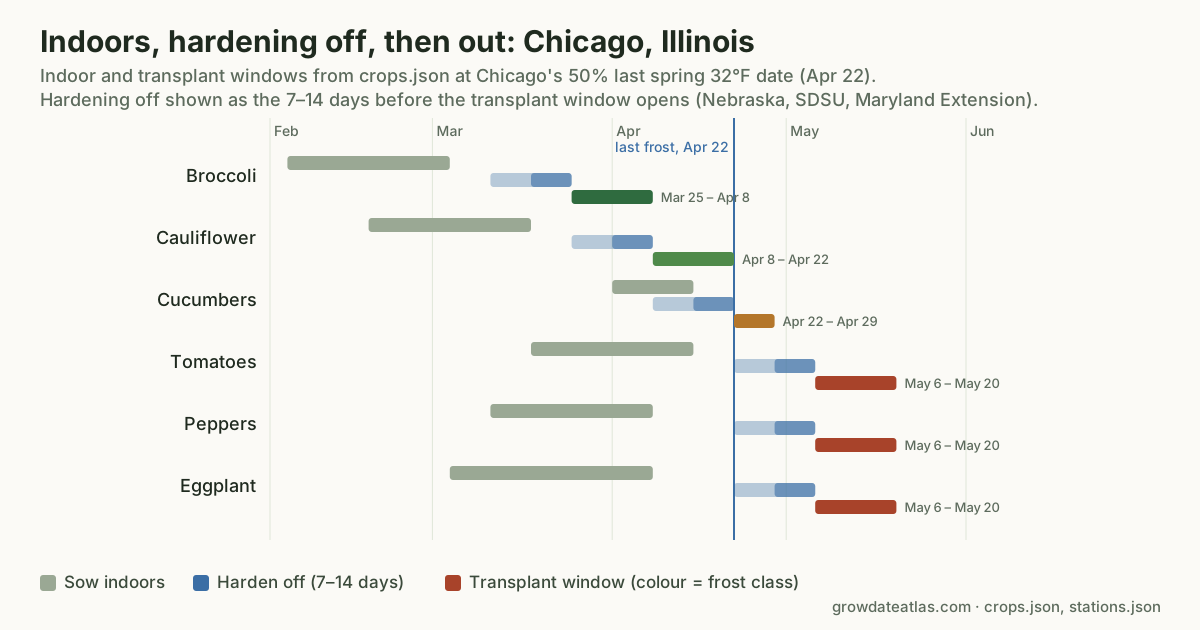
When to harden off seedlings comes down to one date: start 7 to 14 days before the crop's transplant window opens. Nebraska, South Dakota State and Maryland extension services all give a 1-to-2-week hardening period. The transplant window itself is set by your last frost date and the crop's frost class, so tomatoes in Chicago start hardening off between April 22 and April 29, while broccoli at the same station starts between March 11 and March 18.
This guide sets out the extension hardening-off schedules, then works the start dates through for every transplanted crop on the site using the same NOAA 1991–2020 frost dates and Colorado State University Extension rules as the city planting calendars. The schedules are quoted from named extension sources. The dates are arithmetic on a named weather station. Nothing here describes a test anyone at this site ran.
What hardening off does
A seedling raised indoors has grown up in still air, steady temperatures and filtered light. Moving it straight into wind, full sun and cold nights can stall or damage it. Hardening off is a short, gradual exposure to outdoor conditions so the plant toughens before it is planted out.
Colorado State's Vegetable Planting Guide covers it in one line for the cole crops: before planting out, harden off seedlings. It gives no schedule. The detail comes from other extension services, and they agree closely.
How long to harden off seedlings
| Source | How long | When to start |
|---|---|---|
| Nebraska Extension (Sarah Browning, 2020) | 7–10 days | Begin on a mild or cloudy day |
| SDSU Extension (updated 2021) | 7–14 days | At least one week before planting |
| University of Maryland Extension (updated 2023) | 1–2 weeks | 1–2 weeks before setting plants out |
Taken together: plan on two weeks and expect to need at least one. The longer figure is worth using as a start date because spring weather will cost you days. SDSU says to keep plants indoors when daytime temperatures are expected below 45°F or when strong wind or rain is forecast, and Maryland gives the same 45°F limit for tender seedlings. A cold week in the middle of a 7-day plan leaves you with no hardening done on the day you meant to transplant.
A day-by-day hardening off schedule
The three sources describe the same progression with slightly different numbers:
- First day. Nebraska: set plants outdoors in shade for 2 to 3 hours, out of strong wind, then bring them back in. SDSU: 3 to 4 hours in a protected spot during the warmest part of the day.
- Each following day. Add a few hours outdoors and a little more sun. Maryland: gradually increase sun exposure each day, starting from a shaded, protected spot.
- Evenings. Bring plants in at night. SDSU says to do this each evening until the last day or two.
- Last stage. Nebraska: after several days at 10 to 12 hours outside, leave plants out for 24 hours a day for a couple of days. SDSU: leave them out for 24 hours for the final one or two days if night temperatures look favourable.
- Planting day. SDSU suggests a cloudy day, planting early in the morning or in the evening, watering thoroughly, and watering each morning until roots are established.
Two more points appear in more than one source. Water less often during hardening, but never let the seedlings wilt; Nebraska, SDSU and Maryland all say so. And skip fertilizer: Nebraska says not to fertilize before or during hardening, and SDSU says to fertilize only if a deficiency appears. A cold frame, which can be opened by day and closed at night, is described by both Nebraska and Maryland as a good place to harden plants.
When to harden off seedlings, crop by crop
The hardening start date is the transplant date minus 7 to 14 days. The transplant date comes from Colorado State's frost classes, applied to the 50% last spring 32°F date:
| Crop | Frost class | Transplant window | Start hardening off |
|---|---|---|---|
| Broccoli, cabbage | Hardy | 4 to 2 weeks before frost | 6 to 5 weeks before frost |
| Cauliflower | Semi-hardy | 2 weeks before to frost date | 4 to 3 weeks before frost |
| Cucumbers, summer squash | Tender | Frost date to 1 week after | 2 to 1 weeks before frost |
| Tomatoes, peppers, eggplant | Very tender | 2 to 4 weeks after frost | Frost date to 1 week after |
| Cantaloupe, watermelon, winter squash | Very tender | 2 to 4 weeks after frost | Frost date to 1 week after |
Those starts are measured from the opening of the transplant window, so they are the earliest sensible dates. If you plan to transplant later in the window, start hardening later too.
Two things stand out. The hardy brassicas are hardened off five or six weeks before the last frost, in what still feels like late winter in most cities. And the very tender crops start hardening on or just after the last frost date, which is exactly when many gardeners think they should be planting them. Hardening off fills the two weeks between the frost date and the tomato transplant window.
Hardening off dates for four cities
Applied to each station's own last spring frost date:
| Crop | Concord, NH (May 13) | Chicago, IL (Apr 22) | St. Louis, MO (Apr 3) | Atlanta, GA (Mar 20) |
|---|---|---|---|---|
| Broccoli, cabbage | Apr 1 – Apr 8 | Mar 11 – Mar 18 | Feb 20 – Feb 27 | Feb 6 – Feb 13 |
| Cauliflower | Apr 15 – Apr 22 | Mar 25 – Apr 1 | Mar 6 – Mar 13 | Feb 20 – Feb 27 |
| Cucumbers, summer squash | Apr 29 – May 6 | Apr 8 – Apr 15 | Mar 20 – Mar 27 | Mar 6 – Mar 13 |
| Tomatoes, peppers, eggplant | May 13 – May 20 | Apr 22 – Apr 29 | Apr 3 – Apr 10 | Mar 20 – Mar 27 |
Each date range is the opening of that city's transplant window minus 14 days to minus 7 days. The chart at the top of this page draws the Chicago column alongside each crop's indoor sowing window and transplant window, so the whole spring sequence for a transplanted crop sits on one line: sow indoors, harden off, plant out.
The four cities sit 54 days apart from Atlanta to Concord, the same gap as their last frost dates. Concord's broccoli hardening starts on April 1, 54 days after Atlanta's on February 6. A hardening calendar that gives one national date for "early spring" cannot be right for both.
The ends of the range
The pilot cities stretch the calendar further than those four suggest. In Houston, where the 50% last spring 32°F date is February 18, broccoli and cabbage start hardening off from January 7 to January 14, and tomatoes from February 18 to February 25. In Denver, with a last spring frost of May 6, the same tomato hardening runs from May 6 to May 13, eleven weeks after Houston's. Seattle sits in between at March 8 to March 15 for tomatoes, but Colorado State's warning about cool spring winds and daytime temperatures below 60°F is worth reading twice there: the frost date arrives early, and the warmth very tender crops need may not.
Hardening off warm-season crops
Hardening off makes a seedling tougher. It does not make it frost-proof, and the sources are clear about the limits for warm-season crops.
Nebraska Extension says warm-season plants need night temperatures of at least 60°F and cannot tolerate freezing, even after hardening off. Colorado State describes very tender crops as intolerant not only of frost but of cool spring winds, needing daytime temperatures above 60°F, and warns that a week below 55°F may stunt the crop. Maryland adds that cucumbers and melons stop growing if hardened too severely, and can stay out overnight only if it will not drop below 50°F.
Maryland does make one claim in tomatoes' favour: properly hardened tomatoes usually tolerate light, unexpected frosts with minimal damage. Read that as a safety margin, not a reason to plant early. The very tender transplant window already starts two weeks after the 50% last frost date for this reason.
Hardening off cool-season crops
The cole crops are where hardening off pays most, and where it can also go wrong.
Nebraska Extension says hardy cool-season plants tolerate temperatures in the 40s, and once well hardened off, light frosts will not harm them. That is what lets broccoli and cabbage go out two to four weeks before the last frost. Maryland adds a warning that applies to all transplants: exposure to freezing temperatures before hardening can injure even cold-hardy plants. The order matters. Harden first, then plant out into the cold.
Cauliflower is the exception to watch. Maryland notes that if hardening stops cauliflower's growth entirely, it produces thumb-sized heads and fails to develop further. Gentle hardening, not harsh, is the aim for that crop.
The crops you never need to harden off
Hardening off only applies to transplants. Sixteen of the 27 crops on this site have no age of transplant in Colorado State's guide, so the city pages show no indoor date for them and they never go through hardening: beets, carrots, kohlrabi, leaf lettuce, green onions, dry onions from seed, onion sets, parsnips, peas, potatoes, radishes, spinach, Swiss chard, turnips, snap beans and sweet corn.
The cucurbits sit between the two groups. Colorado State gives cantaloupe, cucumbers, summer squash, winter squash and watermelon a transplant age of only 2 to 3 weeks, and says vine crop roots are extremely intolerant of being disturbed and perform best when direct-seeded. If you do start them indoors, the same guide says to use small, young plants no more than 2 to 3 weeks from seeding. Their hardening period then overlaps most of their time indoors. Direct sowing on the date in your city's table avoids the problem.
Fitting hardening off into the seed-starting calendar
Hardening off is the last week or two of a seedling's indoor life. It does not add time to the schedule; it uses the end of it. A tomato with a 5-to-7-week transplant age spends its final 1 to 2 of those weeks going in and out of the house.
That means the indoor sowing dates in the seed-starting guide already include the hardening period. Sow on those dates, start hardening 7 to 14 days before the transplant window opens, and the seedlings will be ready when the window does.
If your garden frosts later than the station, every date in this guide moves with it. The planner tool can shorten the season at both ends by a number of days you choose and recalculate every transplant window. Hardening off then starts 7 to 14 days before the new dates. The number of days to shift is your own judgement about your garden; no NOAA table publishes it.
The short version
Harden off seedlings over 7 to 14 days, starting that far ahead of the crop's transplant window. Start with a few hours in shade, add time and sun each day, bring plants in at night until the last day or two, water less but never let them wilt, and keep them in below 45°F or in strong wind. Hardy brassicas start hardening five to six weeks before the last frost; tomatoes, peppers and eggplant start on the frost date or a week after it. Direct-sown crops need none. Work out the transplant window from your city's frost date, count back two weeks, and you know when to harden off seedlings.
Sources
- Sarah Browning, Hardening Off Transplants, Nebraska Extension in Lancaster County, April 21, 2020. Retrieved 2026-10-17.
- Kristine Lang, Cindy Schnabel and Geoffrey Njue, Harden Your Transplants Prior to Planting Your Garden, SDSU Extension, updated May 13, 2021. Retrieved 2026-10-17.
- University of Maryland Extension, Hardening Off Vegetable Seedlings for the Home Garden, updated February 20, 2023. Retrieved 2026-10-17.
- Colorado State University Extension, Vegetable Planting Guide, CMG GardenNotes #720, reviewed September 2024: frost classes, outdoor timing, age of transplant. Retrieved 2026-10-17.
- NOAA/NCEI U.S. Climate Normals 1991–2020, data type ANN-TMIN-PRBLST-T32FP50: the 50% probability last spring 32°F date at each station. Retrieved 2026-10-16.
Frequently asked questions
How many days does it take to harden off seedlings?
Seven to fourteen days. Nebraska Extension says to harden plants gradually over 7 to 10 days, South Dakota State University Extension says to plan for 7 to 14 days, and University of Maryland Extension says to begin 1 to 2 weeks before setting plants out. Starting 14 days ahead leaves room for days too cold or windy to put trays out.
When should I start hardening off tomato seedlings?
About 7 to 14 days before the tomato transplant window opens, which is 2 weeks after your 50% last spring frost date. In Chicago, where that frost date is April 22, tomatoes go out from May 6, so hardening off starts April 22 to April 29. In Concord, New Hampshire it starts May 13 to May 20.
Can seedlings stay out overnight while hardening off?
Only near the end, and only on mild nights. Nebraska Extension leaves plants out for 24 hours for a couple of days after several days at 10 to 12 hours outside. SDSU Extension brings plants in each evening until the final one or two days. Maryland Extension says cucumbers and melons can stay out overnight if it will not drop below 50°F.
Do I need to harden off direct-sown seeds?
No. Hardening off is for plants raised indoors and moved outside. Seeds sown straight into the garden grow up in outdoor conditions from the start. On this site, 16 of the 27 crops have no indoor sowing date in the source used, so they never need hardening off.
What temperature is too cold for hardening off seedlings?
SDSU Extension says to keep transplants indoors if daytime temperatures are expected below 45°F, or if strong wind or rain is forecast. Maryland Extension gives the same 45°F limit for tender seedlings. Nebraska Extension notes that warm-season plants need nights of at least 60°F and cannot tolerate freezing even after hardening off.