Soil Temperature for Planting Vegetables: Crop by Crop
Soil temperature for planting vegetables, crop by crop from Colorado State Extension, how to measure it at 4 inches, and how it fits your frost dates.
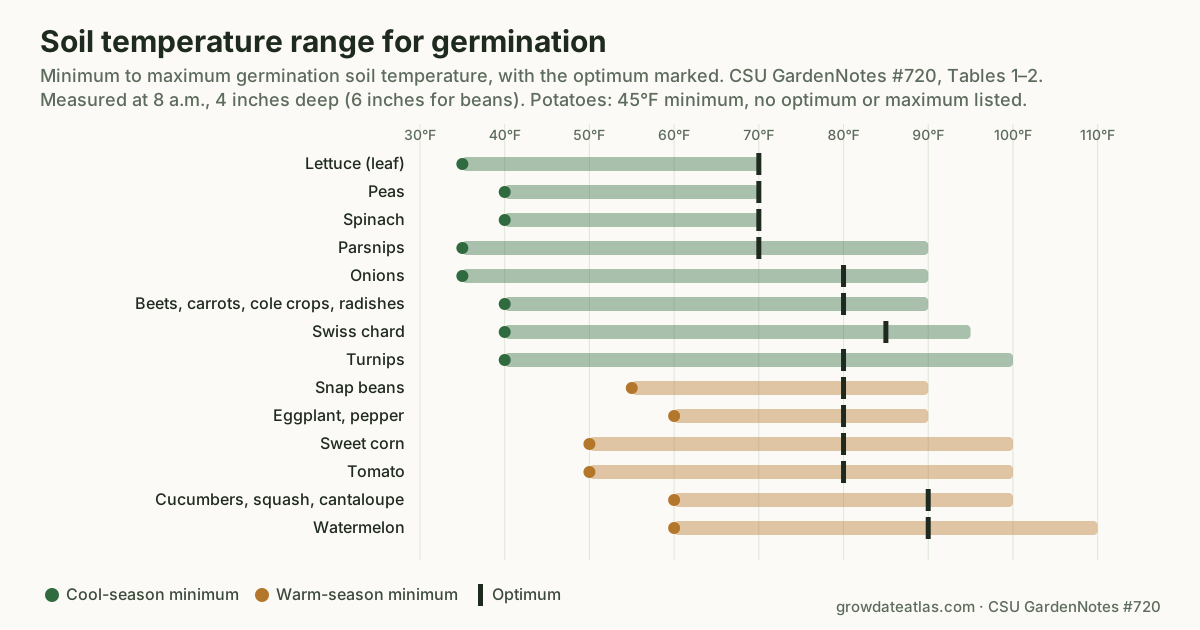
Soil temperature for planting vegetables ranges from 35°F for leaf lettuce, onions and parsnips to 60°F for peppers, eggplant, melons, cucumbers and squash. Those are the minimum germination soil temperatures in Colorado State University Extension's Vegetable Planting Guide, measured at 8 a.m., 4 inches deep. Below them, seed sits and waits; at the optimum, which is 70°F to 90°F for most crops, it comes up fastest.
This guide gives the full crop-by-crop table from that source, explains how to take a reading that means something, and shows how soil temperature fits around the NOAA frost dates on every city planting calendar. Every temperature here is quoted from a named extension source. This site does not publish soil temperatures for any city, because NOAA's freeze normals do not include them and no reading was taken by anyone here.
Why soil temperature matters for planting
A frost date answers one question: is a freeze still likely? It says nothing about whether the ground is warm enough for seed to germinate or roots to grow. Colorado State's guide calls soil temperature a key guide for spring planting and says to plant when soils reach the crop's minimum. The methodology page on this site repeats that point, because the calendars cannot measure it.
Cold soil costs more than time. University of Illinois Extension's small-farms blog puts it bluntly: "Planting into cold soil can encourage diseases and even stunt later crop growth." Colorado State's PlantTalk service adds that cold soil can delay germination and slow transplant establishment, and that wet, saturated soil warms more slowly in spring.
So the two numbers do different jobs. The frost date sets the earliest a crop is safe from freezing. The soil temperature tells you whether planting on that date will actually get the crop growing.
Soil temperature for planting vegetables: the full table
Colorado State's germination tables give a minimum, an optimum and a maximum for each crop. The minimum is the planting threshold. The optimum, the guide says, is useful for starting seeds indoors. The maximum refers to high soil temperatures that may interfere with summer germination.
| Crop | Season | Minimum | Optimum | Maximum |
|---|---|---|---|---|
| Leaf lettuce | Cool | 35°F | 70°F | 70°F |
| Onions (green, dry seed, sets) | Cool | 35°F | 80°F | 90°F |
| Parsnips | Cool | 35°F | 70°F | 90°F |
| Beets, broccoli, cabbage, carrots, cauliflower, kohlrabi, radishes | Cool | 40°F | 80°F | 90°F |
| Peas | Cool | 40°F | 70°F | 70°F |
| Spinach | Cool | 40°F | 70°F | 70°F |
| Swiss chard | Cool | 40°F | 85°F | 95°F |
| Turnips | Cool | 40°F | 80°F | 100°F |
| Potatoes | Cool | 45°F | Not listed | Not listed |
| Sweet corn | Warm | 50°F | 80°F | 100°F |
| Tomato | Warm | 50°F | 80°F | 100°F |
| Snap beans | Warm | 55°F | 80°F | 90°F |
| Eggplant, pepper | Warm | 60°F | 80°F | 90°F |
| Cantaloupe, cucumbers, summer and winter squash | Warm | 60°F | 90°F | 100°F |
| Watermelon | Warm | 60°F | 90°F | 110°F |
The chart at the top of this page draws each row as a range from minimum to maximum, with the optimum marked.
Three patterns stand out:
- The seasons split at 50°F. No cool-season crop needs more than 45°F to germinate. No warm-season crop germinates below 50°F. The cool-season vs warm-season crops guide explains how that split decides which side of the frost date each crop is planted.
- Peas, spinach and leaf lettuce have a ceiling of 70°F. Their minimum and optimum sit close to a low maximum, which is why they suit early spring and fail in midsummer.
- Melons and squash want it hot. Their optimum is 90°F. They will germinate at 60°F, but slowly.
Germination versus transplanting
The table is about seed. Transplants are a different question, and the figures are not the same. Colorado State's PlantTalk page on soil temperatures, frosts and planting dates gives rough planting targets of about 45°F for spinach, about 70°F for many squash and melons, and 60°F to 65°F for tomato transplants. Those are higher than the germination minimums for the same crops, because a transplant needs its roots to grow into the bed, not just a seed to sprout.
Both figures are from Colorado State Extension, and both are worth knowing. If you direct-sow, use the germination minimum. If you set out transplants, the PlantTalk targets are the more useful number.
How to measure soil temperature
A soil temperature reading is only useful if it is taken the same way the published figures were. The sources agree on the method.
| Step | What to do | Source |
|---|---|---|
| Depth | About 4 inches; 6 inches for beans | Colorado State guide and PlantTalk |
| Time | Early morning, when the soil is coolest; the guide specifies 8 a.m. | Colorado State |
| Thermometer | A soil thermometer, or a meat thermometer kept only for soil | PlantTalk |
| Where | Several spots in the bed, not one | PlantTalk; Illinois Extension |
| How long | Several days, averaged | Illinois Extension |
| Hard soil | Make a pilot hole with a screwdriver so the probe does not bend | Illinois Extension |
The early-morning rule matters more than it looks. University of Illinois Extension's guide to the soil thermometer as a toolbox tool says soil is usually coolest between 6 and 8 a.m., and that the surface can swing 10 to 20°F in a day while deeper soil changes more slowly. A reading taken on a sunny afternoon can be well above the morning low, and the morning low is what the seed lives through.
Averaging over several days does the same job for weather. One warm morning after a mild night does not mean the bed has warmed. Three or four readings in a row above the crop's minimum do.
How soil temperature fits your frost dates
The calendars on this site schedule every crop from the NOAA 50% last spring 32°F date at a named station, using Colorado State's frost classes. Soil temperature is the check you run before acting on those dates.
For cool-season crops, the frost date usually comes first. Hardy crops such as peas, spinach and radishes go out two to four weeks before the last frost. Their germination minimum is 40°F, and Colorado State says to plant hardy and semi-hardy crops as soon as the soil adequately dries in spring. In Chicago, where the last spring frost is April 22, the hardy window opens March 25. If the soil at 4 inches is still below 40°F on that date, seed will wait in cold ground.
For warm-season crops, soil temperature usually comes last. Very tender crops go out two to four weeks after the frost date, and need soil of 60°F for eggplant, pepper, melons and cucumbers. Colorado State also wants daytime air consistently above 55°F for them. A tomato transplant set out in Chicago on May 6, the start of its window, into soil still below its target will survive but sit still. The PlantTalk target of 60°F to 65°F is the reading to wait for.
| Group | When the calendar opens | Soil check before planting |
|---|---|---|
| Hardy (peas, spinach, radishes) | 4 to 2 weeks before last frost | At least 40°F, and soil dry enough to work |
| Semi-hardy (beets, carrots, chard) | 2 weeks before to frost date | At least 40°F; 35°F for parsnips |
| Tender (beans, corn, cucumbers, squash) | Frost date to 1 week after | 50°F corn, 55°F beans, 60°F cucurbits |
| Very tender (tomatoes, peppers, melons) | 2 to 4 weeks after frost | 50°F to 60°F for seed; 60°F to 65°F for tomato transplants |
The calendar date is the earliest you should plant. The soil reading tells you whether that earliest date is also a good one this year.
Warming cold soil
If the soil is behind the calendar, the sources suggest a few ways to help it along.
Colorado State's frost-protection guide, GardenNotes #722, recommends black plastic mulch to warm the soil when growing early tomatoes in water-filled plant protectors, noting that cold soil limits early production. The same guide describes plastic covers on frames, which in its Fort Collins trials added two to six weeks or more to both ends of the season.
Drainage matters too. PlantTalk's point that wet, saturated soil warms more slowly in spring is a reason not to work or plant a waterlogged bed early, quite apart from the damage that does to soil structure. Raised beds, which Colorado State's planting guide suggests at 2 to 4 feet wide, drain and warm sooner than flat ground in most gardens.
None of these changes the frost risk. Warm soil under a tomato does not stop a 32°F night from killing it. They change how fast the crop grows once it is safely in.
Soil that is too warm: summer and fall sowing
The maximum column matters in late summer, when cool-season crops are sown for fall. Colorado State lists 70°F as the maximum germination soil temperature for spinach, peas and leaf lettuce. Nebraska Extension's Fall Vegetable Gardening guide says lettuce, peas and spinach germinate poorly when soil is above 85°F, and suggests shading it with a board or a light mulch. Purdue Extension's fall garden guide likewise suggests a light mulch over seed rows and sowing fall seed a little deeper than in spring.
The fall planting calendar gives the last sowing date for each crop, counted back from the first fall frost. Soil temperature tells you whether a sowing on that date will come up. In a hot August, a spinach sowing made on its date may sit dormant until the soil cools, which uses up days the count-back assumed it would spend growing. That is a good reason to sow fall cool-season crops toward the start of their window rather than on the last day.
Starting seeds indoors: use the optimum
Indoors, you control the temperature, so the optimum column is the one to aim for. Colorado State says its optimum figures are useful for starting seeds indoors. Tomatoes, peppers and eggplant have an optimum of 80°F; the cucurbits 90°F; the cole crops 80°F. Peas, spinach and lettuce, at 70°F, germinate best in cooler conditions.
The seed-starting guide gives the indoor sowing window for each transplanted crop, counted from your last frost date. Germinating those seeds near their optimum is how to make the most of that window. After germination, seedlings go back to air temperature and then through hardening off before they meet the garden soil again.
What this site does and does not tell you
Each city page gives the station's frost dates and a planting window for 27 crops. It does not give a soil temperature, and it does not estimate one from air temperature or latitude. Soil warms at different rates in sand and clay, in sun and shade, in raised beds and flat ground. A number for "Chicago soil" would describe nobody's garden.
The planner tool lets you shift the frost dates for a garden that runs colder or warmer than the station. Many gardeners find their soil readings are the evidence for how much to shift. That judgement is yours; no NOAA table or extension guide publishes it for a particular yard.
The short version
Soil temperature for planting vegetables, measured at 4 inches early in the morning, starts at 35°F to 45°F for cool-season crops and 50°F to 60°F for warm-season ones. Germination is fastest at the optimum, usually 70°F to 90°F. Peas, spinach and lettuce top out at 70°F, so summer sowings need shade or cooler weather. Tomato transplants do best in soil of 60°F to 65°F. Plan from your frost dates, measure the soil over several mornings, and plant when both agree. That is how to use soil temperature for planting vegetables.
Sources
- Colorado State University Extension, Vegetable Planting Guide, CMG GardenNotes #720, reviewed September 2024, Tables 1–2: germination soil temperatures, measurement depth and time, frost classes. Retrieved 2026-10-17.
- Colorado State University Extension, PlantTalk Colorado 1626, Soil Temperatures, Frosts and Planting Dates, adapted by Deryn Davidson from Eric Hammond. Retrieved 2026-10-17.
- University of Illinois Extension, Soil Thermometer: A Useful Toolbox Tool, Small Farms blog, March 31, 2014. Retrieved 2026-10-17.
- David Whiting, Carol O'Meara and Carl Wilson, Frost Protection and Extending the Growing Season, CSU Extension GardenNotes #722, reviewed May 2023. Retrieved 2026-10-17.
- David Lott and Dale Lindgren, Fall Vegetable Gardening, University of Nebraska–Lincoln Extension NebGuide G1343, revised March 2012. Retrieved 2026-10-17.
- NOAA/NCEI U.S. Climate Normals 1991–2020, 50% probability last spring 32°F dates for each station. Retrieved 2026-10-16.
Frequently asked questions
What soil temperature is needed to plant tomatoes?
Colorado State Extension's Vegetable Planting Guide gives tomatoes a minimum germination soil temperature of 50°F and an optimum of 80°F. For setting out tomato transplants, a separate Colorado State PlantTalk page suggests soil of 60°F to 65°F. The first figure is for seed; the second is for transplants going into the garden.
How do I measure soil temperature for planting?
Push a soil thermometer about 4 inches into the bed early in the morning, when the soil is coolest. Colorado State's guide specifies 8 a.m. at 4 inches, or 6 inches for beans. University of Illinois Extension suggests readings in several places over several days, averaged, because surface soil can swing 10 to 20°F in a day.
What is the coldest soil vegetables will germinate in?
35°F, for leaf lettuce, onions and parsnips in Colorado State's tables. Beets, broccoli, cabbage, carrots, cauliflower, kohlrabi, radishes, peas, spinach, Swiss chard and turnips need 40°F, and potatoes 45°F. Germination at the minimum is slow; the optimum for most of these crops is 70°F to 85°F.
Can soil be too warm to plant?
Yes. Colorado State lists a maximum germination soil temperature of 70°F for spinach, peas and leaf lettuce, and says high soil temperatures may interfere with summer germination. Nebraska Extension says lettuce, peas and spinach germinate poorly above 85°F and suggests shading the soil with a board or light mulch for summer sowings.
Should I plant by soil temperature or by frost date?
Use both. The frost date tells you when frost is no longer likely to kill a crop; soil temperature tells you whether seed will germinate and transplants will grow. Colorado State calls soil temperature a key guide for spring planting. Plan from the frost date, then check the soil before you sow.